
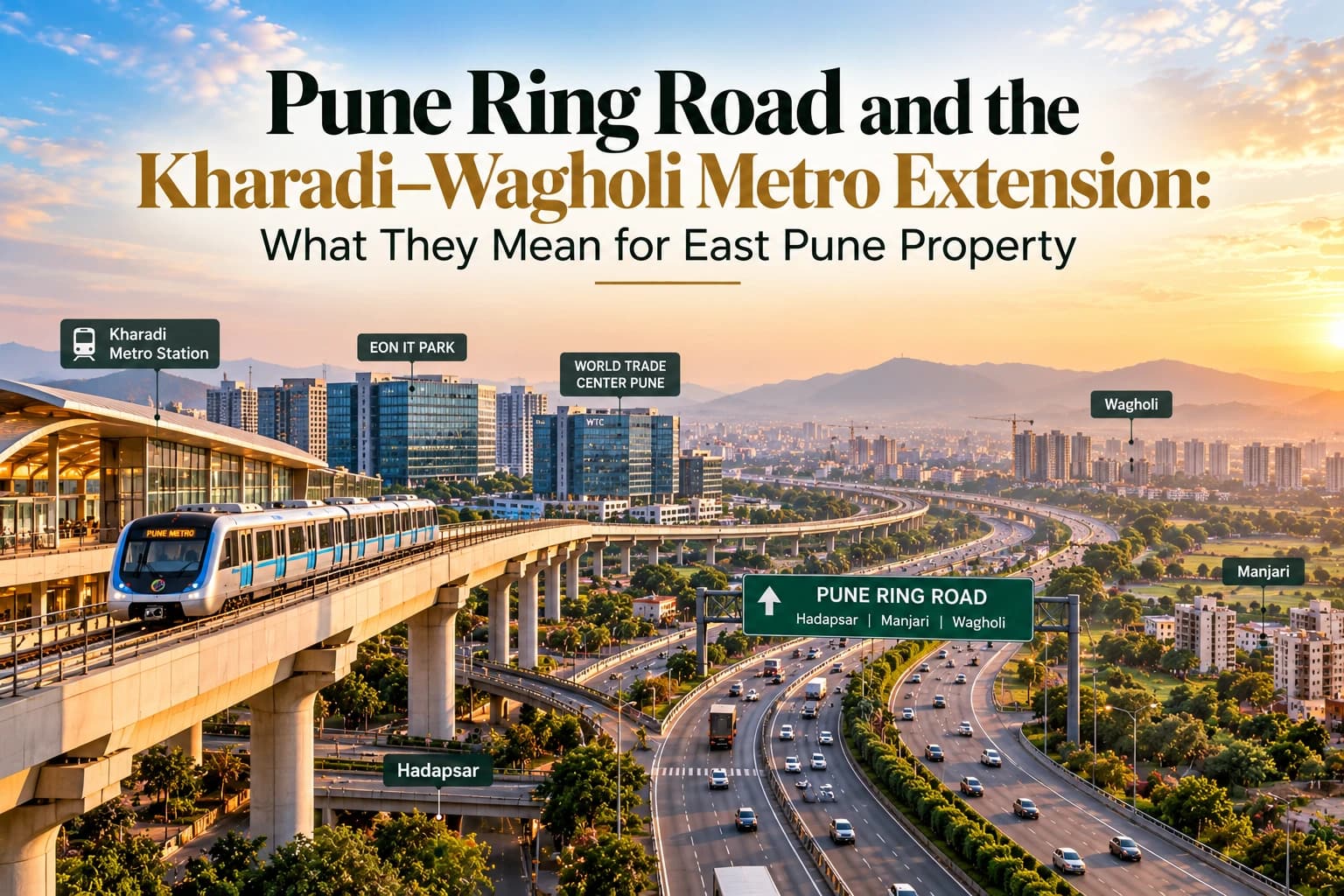
Pune Ring Road and the Kharadi–Wagholi Metro Extension: What They Mean for East Pune Property
Ask anyone who commutes along Nagar Road or the Solapur Highway and they'll tell you East Pune's biggest problem is getting around. Two major projects aim to change that: the metro extension from Ramwadi to Wagholi, and the Pune Ring Road. Both have moved forward in 2026, and both are already shaping how buyers think about East Pune property prices.
This article explains what each project involves, where it stands, and the realistic Pune Ring Road and Kharadi metro impact on property in Kharadi, Wagholi and Manjari, along with how buyers should factor it into their decisions.
The Ramwadi–Wagholi Metro Extension
What Is It?
The Ramwadi–Wagholi metro is an eastern extension of Pune Metro's Aqua Line, which currently runs from Vanaz to Ramwadi. Officially called Corridor 2B, it will run largely above Nagar Road, from Ramwadi to Wagholi and on to Vitthalwadi.
The planned stations are:
- Viman Nagar
- Somnath Nagar
- Kharadi Bypass
- Tuljabhavani Chowk
- Ubale Nagar
- Upper Kharadi Road
- Wagheshwar Temple
- Wagholi
- Siddharth Nagar
- Bakori Phata
- Vitthalwadi
Where It Stands
The Pune Metro extension to Wagholi has cleared its key approvals. The Union Cabinet approved it as part of Pune Metro Phase 2, and the central government formally notified the alignment in May 2026. Maha Metro floated tenders for the first section, a viaduct of about 4.8 km from Ramwadi to Tuljabhavani Chowk with four stations, combined with a six-lane elevated road above Nagar Road. Preparatory work, including barricading near Ramwadi station for soil testing, began in September 2026.
When Will It Be Ready?
So, when will the Ramwadi–Wagholi metro be ready? Reports around the central approval pointed to completion by about 2029. Metro projects often take longer than planned, especially when built above a busy road, so treat 2029 as a target rather than a promise. The first four stations, up to Tuljabhavani Chowk, are likely to open before the stretch towards Wagholi.
Which Areas It Serves
The line will bring a Kharadi metro station at Kharadi Bypass, and stations at Ubale Nagar and Upper Kharadi Road closer to the newer residential belt. It won't reach every part of Kharadi: much of the interior and the area around the IT parks will still be a short drive or ride from the nearest station.
The Pune Ring Road
What Is It?
The Pune Ring Road is a high-speed, access-controlled expressway being built by MSRDC around the city, planned at about 169 km in total. Its purpose is to let traffic travelling between highways bypass Pune's congested roads, linking major routes including the Pune–Solapur Highway, the Pune–Ahmednagar Road, the Mumbai–Pune Expressway and the Pune–Satara road.
The Pune Ring Road Route in East Pune
For East Pune, two parts of the Pune Ring Road route matter most:
- The Nagar Road–Solapur Highway section: part of the eastern alignment, about 24.5 km long, running between the Pune–Ahmednagar Road and the Solapur Highway. The contractor has set up operations near Kesnand, close to Wagholi.
- The Solapur Highway–Satara Road extension: a 31.8 km stretch from Soratapwadi on the Solapur Highway to Varve Budruk on the Satara road. In 2026, Maharashtra granted ₹10,502 crore in administrative approval for this section, clearing the way for land acquisition and construction.
Pune Ring Road Status
On Pune Ring Road status, progress is uneven. The western section was reported to be about 30% complete in September 2026, with officials targeting its opening by December 2027 and the eastern section by December 2028. Independent trackers have suggested the full project could take until around 2030. As with the metro, plan around a range of dates rather than a single one.
The Hadapsar–Yavat Elevated Highway
A third project matters especially for Manjari and Hadapsar. The Hadapsar–Yavat elevated road is a planned 31.5 km, six-lane elevated highway along the Pune–Solapur Highway, approved at a cost of about ₹5,262 crore. Once built, it should separate long-distance traffic from local traffic, easing one of East Pune's most congested corridors.
Together with the metro and the Ring Road, it's a big part of the East Pune infrastructure pipeline over the next several years.
What It Means for Each Part of East Pune
Viman Nagar and Core Kharadi
The metro adds a convenient rail option at Viman Nagar and Kharadi Bypass, linking these areas directly to the city centre via the Aqua Line. Because these neighbourhoods are already established and well priced, the benefit is mainly better daily commuting rather than a dramatic price jump.
Upper Kharadi and the Belt Towards Wagholi
This is where the combined effect could be strongest. The planned stations at Ubale Nagar, Upper Kharadi Road and Wagheshwar Temple serve the newer residential belt, and the Ring Road section near Kesnand adds regional connectivity. Among the best areas to buy near Pune metro over the next few years, this belt stands out, though a large pipeline of new launches here may limit how fast prices rise.
Wagholi
Wagholi gets both a metro station and proximity to the Ring Road, which could ease one of East Pune's worst traffic bottlenecks once complete. Its relatively lower prices give it room to benefit, but it's also the area most exposed to construction disruption along Nagar Road in the meantime.
Manjari and the Hadapsar Belt
Manjari won't get the metro under current plans. Its gains come from roads: the Ring Road's eastern section crossing the Solapur Highway and the Hadapsar–Yavat elevated highway. For property near Pune Ring Road and the Solapur corridor, the main benefit will be easier regional travel and less congestion on the highway.
How Infrastructure Really Affects Property Prices
The Pune Ring Road impact on property prices, and the metro's, is real but often misunderstood. A few patterns are worth knowing:
- Prices move in stages. Some of the expected benefit gets priced in at announcement, more when construction visibly starts, and the rest once the project is actually running.
- Distance matters a lot. A home within walking distance of a station usually benefits far more than one a few kilometres away.
- Construction hurts before it helps. Building a metro viaduct and elevated road above Nagar Road will mean years of diversions and congestion.
- Supply matters too. If many new projects launch near a new station, they compete for buyers and can slow price growth.
For homebuyers, these projects mostly mean a better daily life once they're finished. For investors, any capital appreciation depends on buying at a sensible price before the benefits are fully priced in, and holding long enough for the projects to finish.
The Risks to Keep in Mind
- Delays: large infrastructure projects in India often finish later than planned.
- Alignment changes: station locations and road routes can shift during detailed planning.
- Land acquisition: especially for the Ring Road, this can slow progress.
- Overpaying: be wary of sales pitches that justify a high price with a station that's still years away or several kilometres from the project.
How Buyers Should Use This Information
- Measure the real distance. Check how far your tower is from the nearest planned station or Ring Road interchange, not just which area it's in.
- Check official sources. Look for updates from Maha Metro and MSRDC rather than relying on sales brochures.
- Buy on today's fundamentals. Make sure the home works for you with current infrastructure, and treat future projects as a bonus.
- Line up the timelines. Compare the project's registered possession date on MahaRERA with the infrastructure targets.
- Expect disruption. If you'll be living along Nagar Road during construction, factor in a few years of heavier traffic.
Two Examples: Godrej Ivara and Birla Evam
Godrej Ivara, Kharadi
Godrej Ivara is a 12.8-acre Godrej Properties project in the newer part of Kharadi towards Wagholi, offering 2, 3 and 4 BHK homes from about ₹1.29 crore. It's under construction, with registered possession in August 2032.
If the metro meets its target, it should be running well before residents move in. The planned stations at Ubale Nagar and Upper Kharadi Road, and the Ring Road section near Kesnand, are the projects most relevant to this belt. Ask the developer for the walking or driving distance from your tower to the nearest planned station.
Birla Evam, Manjari
Birla Evam is a 16.5-acre Birla Estates project in Manjari Budruk, offering 2 and 3 BHK homes from about ₹73 lakh all-inclusive, according to Birla Estates. It's under construction, with registered possession on 30 June 2031.
Birla Evam won't benefit from the metro under current plans. Its connectivity story rests on the Solapur Highway: the Hadapsar–Yavat elevated road and the Ring Road's eastern section crossing the highway could make regional travel and commuting noticeably easier once they're built.
For a full side-by-side look at the two areas, see our guide to Kharadi vs Manjari.
Frequently Asked Questions
Q1. Is the Ramwadi–Wagholi metro approved?
Yes. It has been approved by the Union Cabinet as part of Pune Metro Phase 2 and was formally notified in May 2026. Preparatory work on the first section began in September 2026.
Q2. Will there be a metro station in Kharadi?
Yes. The planned Aqua Line extension includes Kharadi Bypass station, along with stations at Ubale Nagar and Upper Kharadi Road nearer the newer residential belt.
Q3. When will the Pune Ring Road be complete?
Officials have targeted the western section for December 2027 and the eastern section for December 2028, while independent trackers suggest the full project may take until around 2030.
Q4. Does the metro reach Manjari?
Not under current plans. Manjari's connectivity improvements come from the Pune Ring Road and the Hadapsar–Yavat elevated highway on the Solapur Highway.
Q5. Should I pay more for a home near a future metro station?
Only within reason. A home within walking distance of a station usually benefits most, but some of the expected gain may already be in the price, and projects can be delayed. Make sure the home works for you with today's infrastructure.
Q6. Which East Pune areas benefit most?
Upper Kharadi and Wagholi stand to gain from both the metro and the Ring Road, while Manjari and Hadapsar benefit mainly from road projects on the Solapur Highway.
Conclusion
The Ramwadi–Wagholi metro, the Pune Ring Road and the Hadapsar–Yavat elevated highway together represent the biggest upgrade to East Pune's connectivity in years. For buyers, they're a genuine long-term positive, especially for Upper Kharadi, Wagholi and Manjari. But the smart approach is to buy a home that works today, check the real distance to future stations and roads, and treat infrastructure-driven gains as a bonus rather than a guarantee. That approach holds across Pune real estate.
To see how these projects affect specific homes, explore Godrej Ivara and Birla Evam on Property Bouquet, or call or WhatsApp +91 90901 06101 to speak with an advisor.