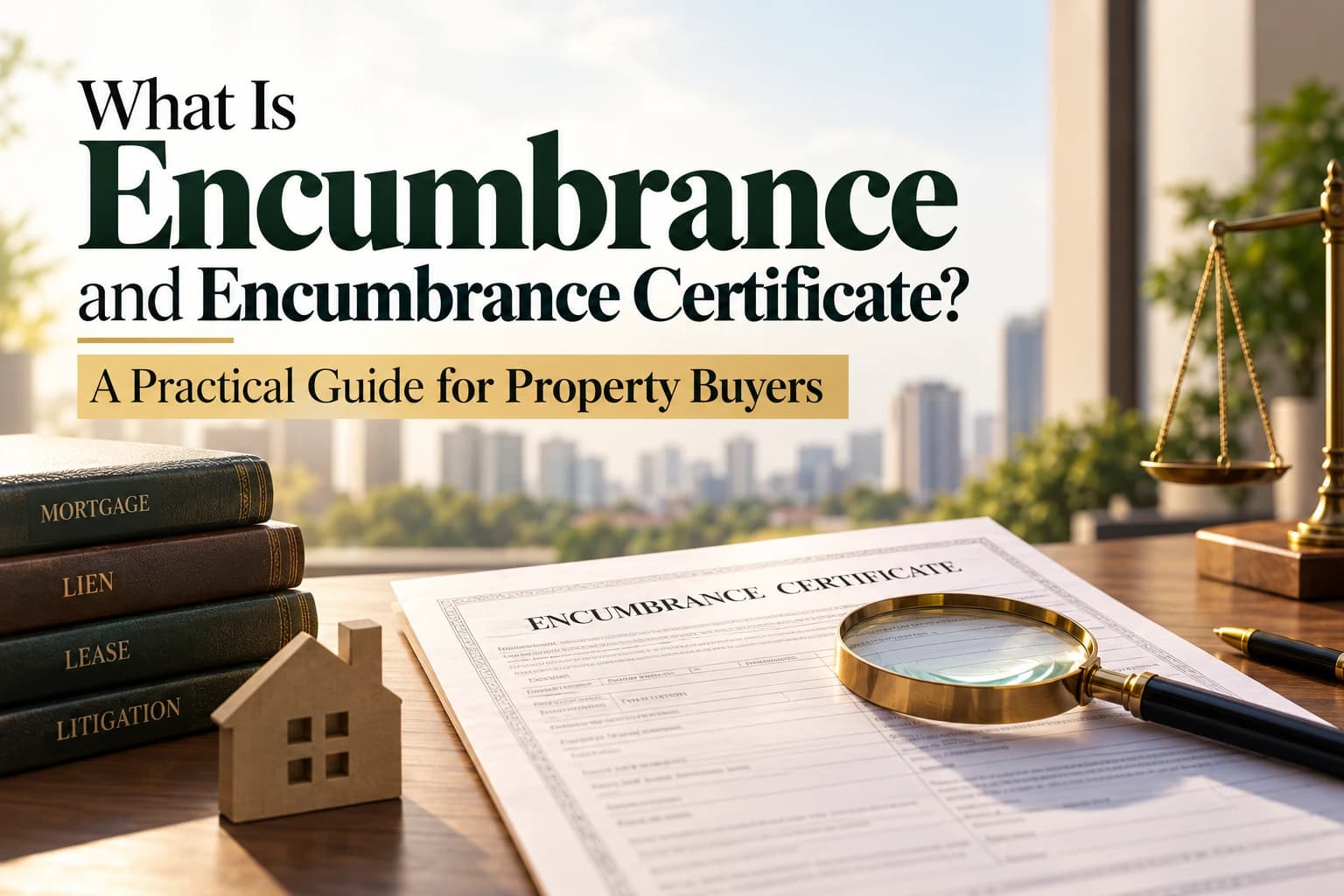
What Is Encumbrance and Encumbrance Certificate? A Practical Guide for Property Buyers
Every property has a history. Some of it is visible, like the name on the nameplate or the builder who constructed it. Much of it is not. A house that looks perfect on a site visit may still be mortgaged to a bank, tied up in a lease, or burdened by an unpaid claim. In property law, these hidden burdens are called encumbrances, and the document that helps bring them to light is the encumbrance certificate.
For anyone buying property, taking a home loan, or checking the value of an inherited asset, understanding both terms is essential. This guide explains what an encumbrance is, what an encumbrance certificate shows, how to apply for one, and where its limits lie.
What Is an Encumbrance on Property?
An encumbrance is any claim, charge, or liability attached to a property that limits the owner's full rights over it. The owner still holds the title, but someone else has a legal interest in the property that must be respected or cleared.
The key point is that an encumbrance generally travels with the property, not with the person. If you buy a flat that has an outstanding mortgage on it, that liability does not disappear simply because the seller has handed you the keys. This is why buyers are advised to purchase only property that is free from encumbrances.
What Are the Common Types of Encumbrances?
Encumbrances come in several forms. Some are financial, some restrict how the property can be used, and some arise from legal proceedings.
Mortgage: The most common encumbrance. When an owner borrows against a property, the lender holds a charge on it until the loan is repaid.
Lien: A right held by a creditor to retain or claim against property until a debt is settled. This can arise from unpaid contractors, maintenance dues, or statutory claims.
Lease: A registered long-term lease gives the tenant a legal right to occupy the property for the lease period, even if the property is sold.
Easement: A right enjoyed by someone else over your property, such as a right of way to reach a neighbouring plot or a right to run drainage lines.
Pending litigation: A court case concerning the property, such as a partition suit among heirs or a dispute over title, affects anyone who acquires the property during the case.
Unpaid government dues: Outstanding property tax, stamp duty deficiencies, or other statutory charges may create a claim on the property.
Restrictive covenants: Conditions in the original allotment or conveyance that limit use, such as a bar on commercial activity in a residential plot.
What Is an Encumbrance Certificate?
An encumbrance certificate (EC) is an official document issued by the sub-registrar's office that lists all registered transactions relating to a specific property during a chosen period. It works as a transaction history of the property as recorded in the registration department.
If any sale, mortgage, gift, lease, or release deed concerning the property has been registered during the selected period, it will appear on the certificate along with the date, document number, and parties involved.
In several states, the EC is issued in one of two formats:
- Form 15: Issued when registered transactions are found. It lists each transaction for the period searched.
- Form 16: Issued when no registered transaction is found for the period. This is commonly called a nil encumbrance certificate.
The format, name, and procedure differ from state to state, so buyers should check the rules of the state where the property is located.
Why Is an Encumbrance Certificate Important?
An EC serves several practical purposes in property dealings.
Verifying the seller's claim: It confirms whether the property has been sold, mortgaged, or otherwise transferred during the period, helping you match the seller's story against official records.
Building the chain of title: Along with the title deed and earlier documents, the EC helps establish an unbroken chain of ownership, which is central to confirming a clear title.
Loan approval: Banks and housing finance companies usually ask for an encumbrance certificate before sanctioning a home loan or a loan against property.
Mutation and resale: Revenue and municipal authorities may request an EC while updating ownership records, and future buyers will almost certainly ask for one.
Withdrawal from provident fund: Some employees withdrawing EPF for a house purchase may be asked to submit property documents that include an EC.
How Many Years Should an Encumbrance Certificate Cover?
There is no single rule, but lawyers and lenders generally ask for an EC covering 13 to 30 years. A 30-year search is widely regarded as the safer standard for resale property, since it captures older transactions that might otherwise be missed. For newer properties, the search should at least go back to the date the land was acquired for development.
How to Apply for an Encumbrance Certificate
The process varies by state, and many registration departments now allow online encumbrance certificate applications. In general, the steps look like this:
- Identify the correct sub-registrar office that has jurisdiction over the property
- Fill in the application form, either online on the state registration portal or at the office
- Provide property details such as survey or khasra number, plot or unit number, location, and boundaries
- Specify the period for which the search is required
- Pay the prescribed fee, which depends on the number of years searched and the state's fee schedule
- Collect the certificate once the search is complete, either physically or as a digitally signed copy
Documents Usually Required
- Copy of the title deed or sale deed of the property
- Identity proof and address proof of the applicant
- Property details, including survey number and location
- Reason for the application, where the form asks for it
- Any previous deed references, if available
Processing time varies. Some states issue online ECs within a few days, while manual applications may take two to four weeks.
What Does an Encumbrance Certificate Not Show?
This is where many buyers get caught off guard. An EC is only as complete as the records of the registration office. It has real limitations:
- It shows only registered documents. Unregistered agreements, oral family arrangements, and informal sales will not appear.
- It may not reflect an equitable mortgage by deposit of title deeds, which in many cases is not registered with the sub-registrar. A search on the CERSAI database can help identify charges created by banks and financial institutions.
- It does not reveal pending court cases unless a related document has been registered.
- It does not show unpaid property tax, utility dues, or society maintenance.
- It does not confirm building approvals, the occupation certificate, or RERA registration.
In short, a nil encumbrance certificate is good news, but it is not a complete guarantee. It should be one part of a broader title search and property due diligence, ideally carried out by a property lawyer.
Encumbrance Certificate vs Title Deed: What Is the Difference?
A title deed proves who owns the property and how that ownership was acquired. An encumbrance certificate shows what registered transactions have affected the property over a period. The title deed answers "who owns it?" The EC helps answer "what has happened to it, and is anything still attached to it?"
Buyers need both. A valid title deed on a property with an active mortgage still leaves you exposed, and a nil EC means little if the seller's title itself is defective.
Final Thoughts
An encumbrance can turn a well-priced property into a long legal headache. The encumbrance certificate is one of the simplest and most affordable tools available to spot trouble early. Applying for one, reading it carefully, and matching it against the seller's documents should be a standard step in every property purchase, whether it is a new apartment, a builder floor, or a piece of agricultural land.
When the EC shows transactions you do not understand, stop and ask. A few questions before registration will always cost less than a dispute after it.
Frequently Asked Questions (FAQs)
1. What does "encumbrance-free property" mean?
It means the property has no outstanding mortgage, lien, lease, legal dispute, or other claim attached to it. The owner holds full rights and can transfer it without any third-party interest.
2. Who issues an encumbrance certificate?
The sub-registrar's office under the state's registration department issues the EC for properties falling within its jurisdiction.
3. Can I get an encumbrance certificate online?
Many states offer online applications and digitally signed ECs through their registration portals. Availability and features differ from state to state.
4. Is an encumbrance certificate mandatory for a home loan?
Most banks and housing finance companies ask for one as part of their legal verification, though exact requirements vary by lender.
5. What is a nil encumbrance certificate?
It is a certificate stating that no registered transaction was found for the property during the period searched. In several states, it is issued in Form 16.
6. Can an encumbrance be removed?
Yes. A mortgage is cleared by repaying the loan and registering a release or obtaining a no-objection certificate from the lender. Other encumbrances may be cleared through settlement of dues, surrender of lease, or resolution of litigation.
7. Does a property with a mortgage mean I shouldn't buy it?
Not necessarily. Many resale transactions involve a seller with an existing home loan. The buyer's bank typically pays the seller's lender directly, the original documents are released, and the charge is cleared before or at registration. It needs to be handled carefully and in writing.
8. How much does an encumbrance certificate cost?
The fee depends on the state and the number of years searched. It is usually a modest amount compared to the value of the property.