
Introduction
Imagine you've shortlisted two apartments. Both are advertised as 1,500 sq. ft., both are priced similarly, and both look attractive in the brochure. But when you visit them, one feels noticeably more spacious than the other.
How is that possible?
The answer often lies in Carpet Area.
Carpet area is one of the most important terms every homebuyer should understand before purchasing a property. It tells you how much usable space you'll actually get—not just what appears in the brochure.
Whether you're buying your first apartment, upgrading to a luxury residence, or investing in real estate, understanding carpet area can help you compare properties more accurately and avoid costly mistakes.
What Is Carpet Area?
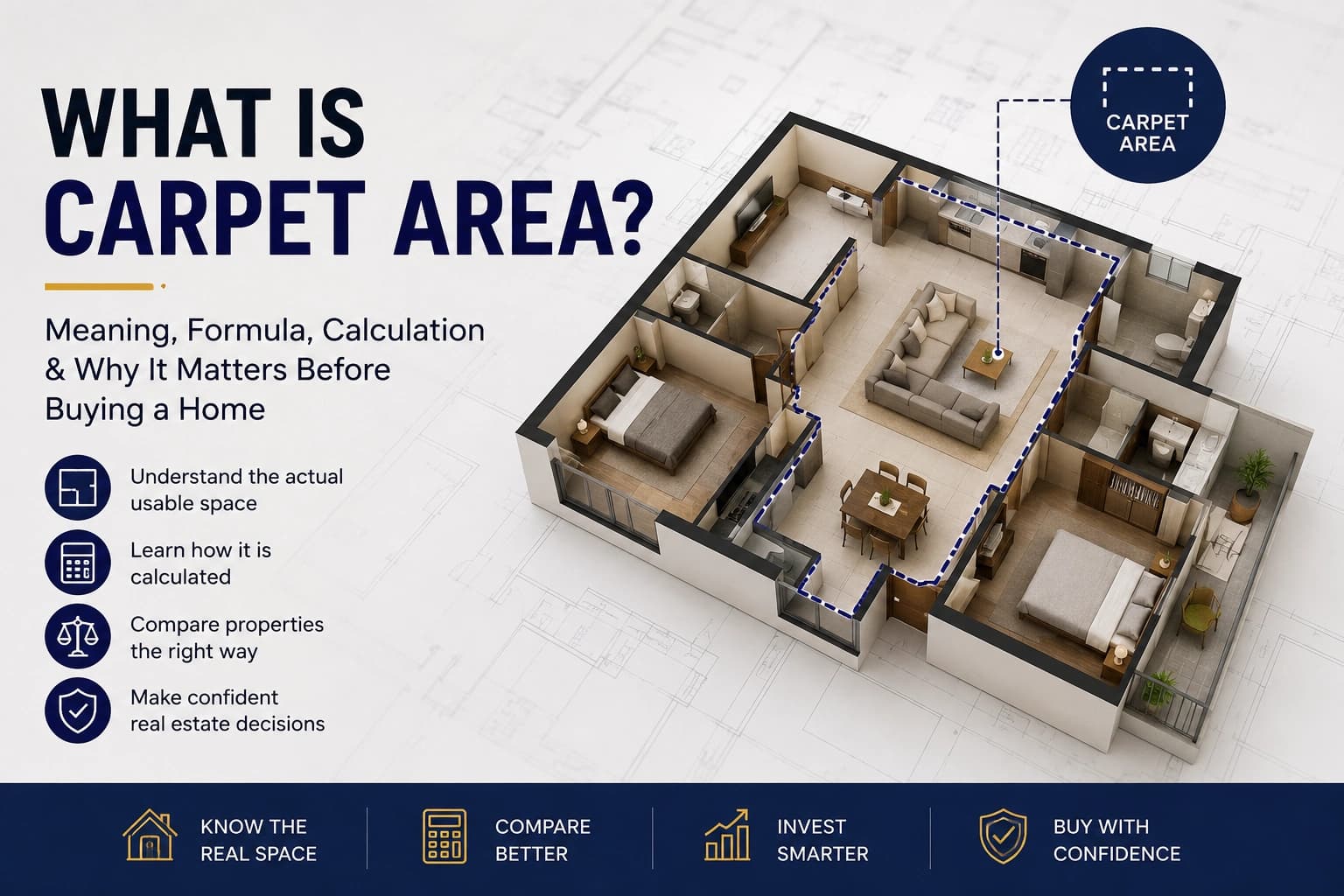
Carpet Area refers to the actual usable floor space inside an apartment.
In simple words, it is the area where you can comfortably place furniture, walk around, and live every day.
It includes all the rooms inside your home, such as the living room, bedrooms, kitchen, bathrooms, and internal passages. However, spaces like balconies, terraces, and common areas are not counted as carpet area.
Under the Real Estate (Regulation and Development) Act (RERA), developers are required to disclose the carpet area using a standardized definition, making it easier for buyers to compare different projects fairly.
RERA Definition: Carpet Area means the net usable floor area of an apartment, excluding external walls, balconies, verandahs, open terraces, and service shafts, while including the area covered by internal partition walls.
Why Is Carpet Area Important?
Many buyers make the mistake of comparing apartments based only on the advertised size. Unfortunately, the advertised area often refers to the Super Built-Up Area, which includes a share of common spaces such as lobbies, staircases, and lift areas.
The carpet area tells a different story.
It shows the actual space you and your family will use every day.
Knowing the carpet area helps you:
- Compare different projects accurately.
- Understand the true value of your investment.
- Avoid paying a premium for unusable space.
- Make better decisions while choosing between multiple properties.
What Is Included in Carpet Area?
The carpet area generally includes:
- Living room
- Bedrooms
- Kitchen
- Dining area
- Bathrooms
- Internal passages
- Store room
- Area covered by internal partition walls
It does not include balconies, terraces, external walls, lift lobbies, staircases, or any common areas shared with other residents.
How Is Carpet Area Calculated?
The calculation is straightforward.
Carpet Area = Total Usable Internal Floor Area + Area Covered by Internal Partition Walls
For example, consider a two-bedroom apartment.
| Room | |
| Living Room | 220 sq. ft. |
| Bedroom 1 | 150 sq. ft. |
| Bedroom 2 | 145 sq. ft. |
| Kitchen | 95 sq. ft. |
| Bathrooms | 70 sq. ft. |
| Internal Passage | 45 sq. ft. |
| Internal Walls | 35 sq. ft. |
| Total Carpet Area | 760 sq. ft. |
If the apartment also has a balcony measuring 120 sq. ft., that balcony is not included in the carpet area.
Carpet Area vs Built-Up Area vs Super Built-Up Area
These three terms are often confused, but they represent different measurements.
| Feature | Carpet Area | Built-Up Area | Super Built-Up Area |
| Usable Living Space | Included | Included | Included |
| Internal Walls | Included | Included | Included |
| External Walls | ❌ | Included | Included |
| Balcony | ❌ | Usually Included | Included |
| Common Areas | ❌ | ❌ | Included |
Key Takeaway: When comparing two apartments, always compare their RERA Carpet Area, not their Super Built-Up Area.
A Real-Life Example
Let's assume two developers are selling apartments.
Developer A advertises a 1,500 sq. ft. apartment with a carpet area of 1,250 sq. ft.
Developer B advertises the same 1,500 sq. ft. apartment, but the carpet area is only 1,080 sq. ft.
Although both apartments appear identical on paper, Developer A offers significantly more usable living space.
This is why experienced buyers always ask for the carpet area before making a decision.
Common Mistakes Buyers Make
One of the biggest mistakes is assuming that a larger advertised size automatically means a larger home.
Another common mistake is comparing the price per square foot without checking whether that figure is based on carpet area or super built-up area.
Many buyers also overlook the RERA documents, relying only on marketing brochures.
These small oversights can lead to paying more for less usable space.
Expert Tip
Whenever you visit a project, ask the sales representative one simple question:
"What is the RERA-approved Carpet Area?"
This single question makes it much easier to compare different properties and ensures you're evaluating the actual living space rather than marketing numbers.
Final Thoughts
Carpet area is more than just a technical real estate term—it's one of the most reliable indicators of the value you're getting from a property.
Before making any purchase decision, don't focus solely on the apartment's advertised size. Instead, compare the RERA-approved Carpet Area, understand what is included, and evaluate how efficiently the available space has been designed.
A clear understanding of carpet area will help you make smarter buying decisions, compare projects fairly, and choose a home that truly fits your lifestyle and budget.