
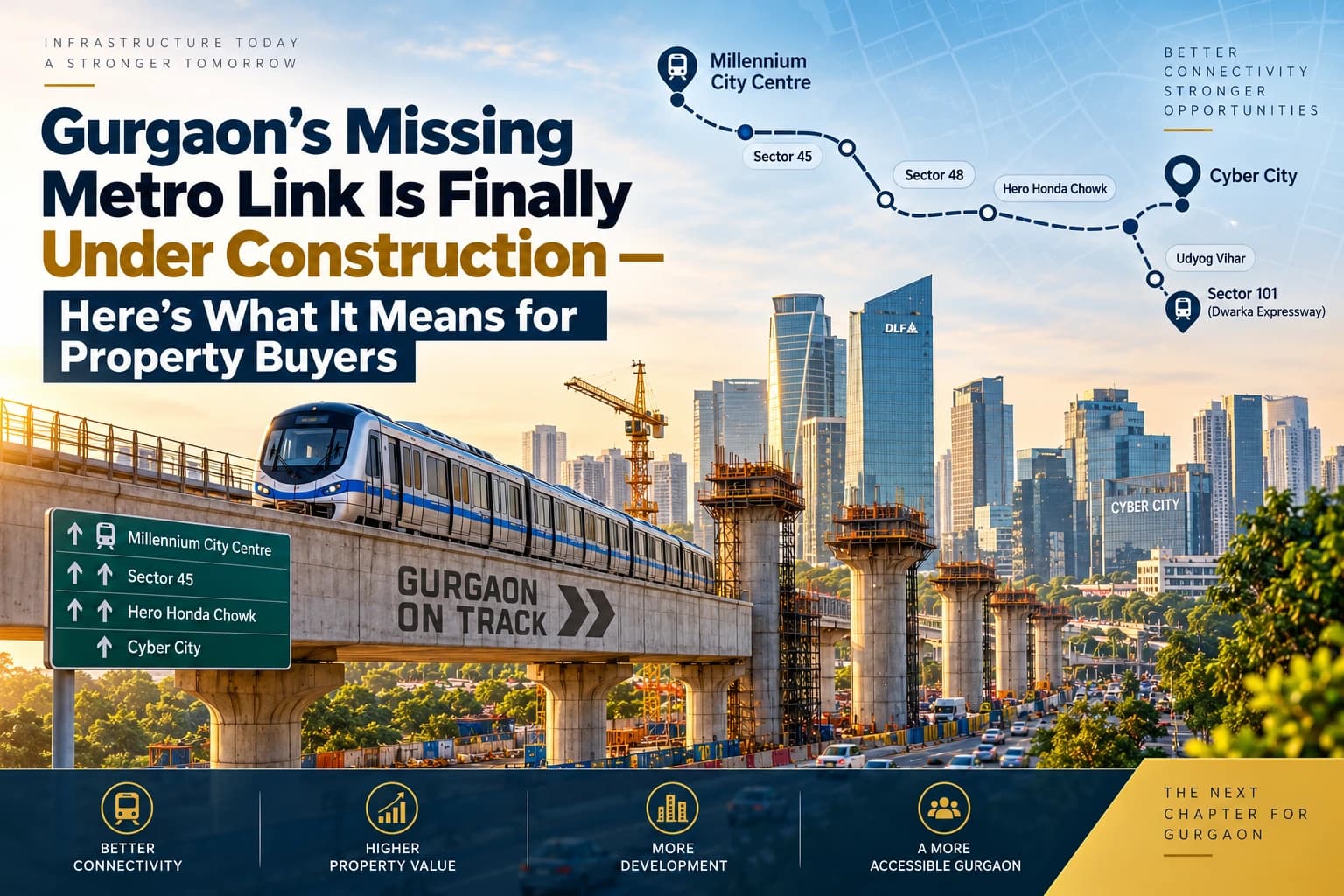
Gurgaon's Missing Metro Link Is Finally Under Construction — Here's What It Means for Property Buyers
The ₹5,452-crore Millennium City Centre–Cyber City metro corridor has moved from paper to pavement. Here's what's actually built, what's still pending, and which pockets of Gurgaon stand to benefit first.
For nearly a decade, one gap in Gurgaon's transit map kept coming up in every investment conversation: there was no metro connecting Old Gurgaon to the city's commercial core.
Cyber City had Rapid Metro. Millennium City Centre had the Delhi Metro Yellow Line. But the stretch in between — Sector 45, Sector 48, Hero Honda Chowk, Udyog Vihar, Basai, and the old city sectors beyond it — had none of it.
That gap is now closing.
Foundation work for the Gurugram Metro Rail Limited (GMRL) corridor has begun, and for the first time, this is a story about construction, not just planning.
What's Actually Being Built
The project is a 28.5-km elevated metro loop connecting Millennium City Centre to Cyber City, executed as a joint venture between the Central Government and the Haryana Government under GMRL.
It is split into two corridors:
Corridor I (Main Line): 26.65 km, Millennium City Centre to Cyber City, with 26 stations.
Corridor II (Spur): A 1.85-km branch from Basai Village to the Dwarka Expressway, terminating at a station near Sector 101.
Together, the alignment is expected to touch some of Gurgaon's most transit-starved pockets: Sector 45, Cyber Park, Sector 47, Subhash Chowk, Sector 48, Hero Honda Chowk, Udyog Vihar (Phases 4, 5 and 6), Basai, Sector 9, Sector 7, Sector 5, Sector 4, Ashok Vihar, Sector 3, Palam Vihar, and Palam Vihar Extension.
The total project cost is pegged at approximately ₹5,452 crore.
Why Phase 1 Is the Part That Matters Right Now
The corridor is being delivered in two phases, and only one of them is currently under active construction.
Phase 1 covers roughly 15.2 km from Millennium City Centre to Sector 9, with a spur to the Dwarka Expressway. It carries an estimated cost of ₹1,286 crore. The civil contract was awarded to a joint venture, and piling and pillar-casting work is already underway across the Sector 45–Cyber Park–Subhash Chowk–Hero Honda Chowk stretch.
Phase 2 covers the remaining loop, roughly 13 km from Sector 9 back to Cyber City. GMRL has already identified land for the stations in this stretch — Sector 7, Sector 4, Sector 5, Ashok Vihar, Sector 3, Palam Vihar Extension, Palam Vihar and Sector 23A — and tenders for this segment were expected to open around March 2026.
In other words: the western half of the loop (New Gurgaon side, via the Dwarka Expressway spur) is ahead in construction. The eastern half (Old Gurgaon side) is still at the tendering and land-identification stage.
For an investor, that distinction changes the timeline for each micro-market quite differently.
The Piece That Got Deferred — And Why It Doesn't Change the Core Timeline
One detail worth flagging for due diligence: a separate 1.8-km spur planned to connect the corridor to Gurgaon Railway Station has been put on hold and is now being evaluated as an independent project, separate from the World Bank-linked funding structure for the main corridor.
This does not affect the Millennium City Centre–Cyber City loop itself. It only means the railway-station link is no longer bundled with the main corridor's 2027 completion target. Buyers evaluating properties specifically for their proximity to a future railway-metro interchange should treat that link as a separate, slower-moving piece — not assume it arrives alongside the rest of the network.
The Depot Detail Investors Often Skip
A metro depot is being developed on roughly 45 acres in Sector 33, at an estimated cost of around ₹409 crore.
Depots are easy to overlook in metro coverage, but they matter for two reasons: they anchor where a phase's operations will actually run from, and depot land generally sees early-stage commercial and warehousing interest well before residential prices around a corridor move.
Which Micro-Markets Get First-Mover Advantage
Not every station on a 28.5-km loop benefits equally, and not on the same timeline.
Immediate beneficiaries (Phase 1 corridor): Sector 45, Cyber Park/Sector 46, Sector 47, Subhash Chowk, Sector 48, Hero Honda Chowk, Udyog Vihar Phase 6, and Sector 101 via the Dwarka Expressway spur. These are the stretches where piling and viaduct work is already visible on the ground.
Later beneficiaries (Phase 2 corridor): Sector 7, Sector 5, Sector 4, Ashok Vihar, Sector 3, Palam Vihar and Palam Vihar Extension. These stand to gain once tendering converts into actual construction — a step that typically follows Phase 1's momentum, not before it.
The broader principle for micro-market selection: proximity to a metro alignment under active construction generally carries a different risk profile than proximity to a metro alignment still at the DPR or tender stage. Both can appreciate — but the timelines, and the patience required, are not the same.
What an Investor Should Actually Verify Before Buying on This Thesis
A metro announcement is not, by itself, an investment thesis. Before pricing in a "metro premium," it's worth checking a few things directly:
Confirm which phase a shortlisted project actually falls under — Phase 1 stretches have a firmer construction timeline than Phase 2 stretches.
Check the walking distance to the nearest proposed station, not just the sector name — metro premiums compress sharply beyond 1–1.5 km.
Track GMRL's own tender and construction updates for Phase 2, since that timeline is still less certain than Phase 1's.
Compare current entry prices in the sector against comparable metro-adjacent sectors elsewhere in NCR at a similar construction stage, to gauge how much of the future connectivity is already priced in.
Project Snapshot
Project: Millennium City Centre – Cyber City Metro Corridor
Implementing Agency: Gurugram Metro Rail Limited (GMRL)
Total Length: 28.5 km (26.65 km main line + 1.85 km Dwarka Expressway spur)
Total Stations: 27
Total Estimated Cost: ~₹5,452 crore
Phase 1: ~15.2 km, Millennium City Centre to Sector 9 + Dwarka Expressway spur; cost ~₹1,286 crore; construction underway
Phase 2: ~13 km, Sector 9 to Cyber City; land identified, tenders in progress
Depot: Sector 33, ~45 acres, ~₹409 crore
Target Completion: 2027 (main corridor)
Timelines and costs are as reported by GMRL and government sources at the time of writing and are subject to revision.
The Bigger Picture
Gurgaon has seen metro announcements before that stayed on paper for years. What makes this update different is simple: there are pillars in the ground.
That doesn't guarantee the appreciation curve will look like Rapid Metro's did in Cyber City, or like the Yellow Line's did in DLF Phase 1 and 2. Every corridor's impact depends on the density, employment base, and existing infrastructure already sitting around it.
But it does mean the conversation around Old Gurgaon connectivity has shifted from "if" to "when" — and for investors watching the western stretch of this corridor in particular, the "when" now has visible construction behind it.
Final Takeaway
The Millennium City Centre–Cyber City metro corridor is no longer a proposal — Phase 1 construction is active, Phase 2 land has been identified, and a completion target of 2027 is on record.
For buyers evaluating property along this alignment, the opportunity isn't uniform across all 27 stations. It's concentrated, for now, along the stretch where construction has already begun — and it will shift toward the Old Gurgaon stations only as Phase 2 moves from tender to ground.
That distinction is the difference between an informed metro-linked investment and a speculative one.
