What Is the Difference Between Freehold and Leasehold Property?
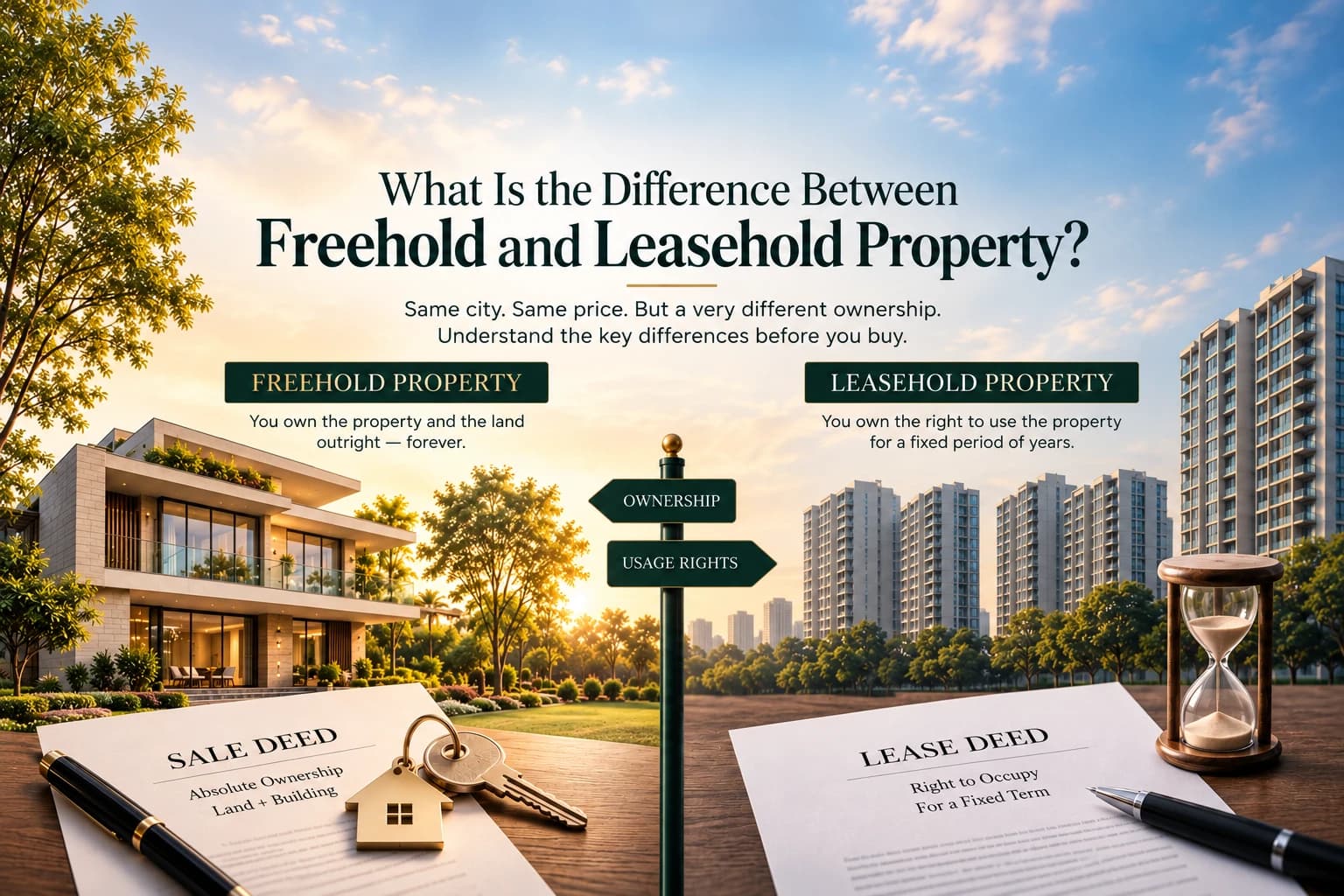
Two apartments in the same city, at the same price, can be very different assets. In one, the buyer owns the flat and the land beneath it outright. In the other, the buyer holds the right to occupy it for a fixed number of years, and the land belongs to someone else. The brochure rarely makes the distinction, but it decides whether you can sell freely, get a home loan easily and pass the property on without complications.
That distinction is freehold versus leasehold, and every buyer should understand it before signing.
What Is Freehold Property?
A freehold property gives you absolute, permanent ownership of both the structure and the land it stands on. There is no expiry date, no landlord and no authority to seek permission from when you sell, rent or redevelop it, apart from the usual building rules and taxes.
Ownership is transferred through a registered sale deed. You can sell the property, gift it, mortgage it or leave it to your heirs, and the title continues in perpetuity.
What Is Leasehold Property?
In a leasehold property, the land remains with a lessor, usually a development authority or a private landowner. The buyer, called the lessee, receives the right to use and occupy the property for a fixed term, typically anywhere between 30 and 99 years. The rights are transferred through a lease deed, and a lease of more than one year must be registered.
Leasehold is most commonly associated with land allotted by authorities such as DDA in Delhi, the Noida Authority, HSVP in Haryana and CIDCO in Maharashtra. You own what is built on the land and the right to occupy it, but not the land itself. When the lease term ends, the land reverts to the lessor unless the lease is renewed or converted.
What Is the Difference Between Freehold and Leasehold Property?
The differences show up in several practical ways.
- Ownership: A freehold owner holds the land and the building outright. A leasehold owner holds a time-limited right to use the land and, in most cases, owns the structure.
- Duration: Freehold is perpetual. Leasehold lasts for the term of the lease, which may be 30, 90 or 99 years.
- Title document: Freehold passes by sale deed or conveyance deed. Leasehold passes by lease deed or sub-lease.
- Transfer and resale: A freehold owner can sell without asking anyone. A leasehold owner often needs the lessor's prior consent or a no-objection certificate, and may have to pay transfer charges.
- Ground rent and dues: Freehold owners pay only property tax and local charges. Leasehold owners may also owe ground rent or lease rent to the authority.
- Home loans: Banks lend more readily against freehold property. For leasehold, lenders look at the remaining lease term, and some banks expect the residual lease to run well beyond the loan tenure.
- Resale value: Freehold properties generally sell faster and at a premium, while leasehold properties may trade at a discount, particularly when the remaining lease is short or conversion has not been done.
- Inheritance: Both can be inherited, but a leasehold heir receives only the balance of the lease term.
Which Cities Have Leasehold Property in India?
The pattern differs by region. In Delhi, DDA flats were historically allotted on a leasehold basis, and the government has periodically offered conversion to freehold. In Noida, Greater Noida and the Yamuna Expressway region, residential land is predominantly leasehold, typically on leases of around 90 years, with the authority retaining ownership of the land. Navi Mumbai's CIDCO plots and several HSVP and HUDA allotments in Haryana have also been given on long lease terms.
In many other markets, including most private developer projects in cities such as Bengaluru, freehold is more common. In Gurgaon, the picture depends on how the land was acquired and allotted, so check the title of the specific property and do not assume.
Why Does Leasehold Affect Loans and Resale?
Because a lender's security is the property, and a shrinking lease term shrinks the security. A bank that finances a property on a lease with 15 years left is funding an asset that may revert to the authority before the loan is repaid. For this reason, banks typically want a comfortable margin of residual lease beyond the loan tenure.
The same logic applies to a resale buyer. A property with 90 years left is a very different proposition from one with 30, and the buyer's price and financing options will reflect it.
What Are the Risks of Buying Leasehold Property?
- Lease expiry: If the lease runs out and is not renewed or converted, the right to the property can be lost.
- Renewal cost: Renewal premiums can be calculated on current land values, which may be far higher than the original allotment price.
- Transfer permissions and charges: In Noida-type leasehold markets, transfers can involve the authority's permission and transfer fees.
- Ground rent and dues: Unpaid lease rent or authority dues can block a sale or conversion.
- Restrictions on use: The lease deed may limit alterations, subletting or change of use without consent.
- Weaker resale and loan options: Both tend to be tighter than for an equivalent freehold property.
Can Leasehold Property Be Converted to Freehold?
Often, yes. Several authorities, including DDA, HSVP and the Noida Authority, have offered conversion schemes in which a leaseholder pays a premium or conversion charge to convert the land title to freehold. In Haryana, for example, conversion premiums have been calculated per square yard by reference to collector rates.
The usual process involves applying to the authority with the lease documents, paying the conversion charge and stamp duty, and executing a conveyance deed that reflects freehold status. Once a property is converted, it generally commands better resale value and loan eligibility.
Schemes, eligibility and charges change from time to time, and some are paused or revised. Check the authority's current notification before you assume conversion is available, or budget for it in your purchase price.
Which Is Better: Freehold or Leasehold?
For most buyers, freehold is the safer and simpler choice. It offers permanence, easier financing and a wider pool of resale buyers. If your priority is long-term wealth, inheritance or investment, freehold is generally the better option.
Leasehold is not necessarily a bad buy, though. If the remaining lease is long, the price reflects the discount, the location is strong and conversion is available, it can offer good value. The question is whether the discount adequately compensates for the added constraints.
What Should Buyers Check Before Buying?
- Ask for the title documents and confirm whether the land is freehold or leasehold.
- Check the remaining lease term and the renewal conditions in the lease deed.
- Find out about ground rent and any pending dues to the authority.
- Ask whether transfer permission or a no-objection certificate is required, and what it costs.
- Confirm the conversion status, including whether the process is open, what it will cost and who pays.
- Check the RERA registration details of the project, since some states require projects to disclose whether the land is leasehold or freehold.
- Speak to your lender about financing before you commit.
- Get a property lawyer to review the deed if anything is unclear.
The Bottom Line
The difference between freehold and leasehold comes down to one question: do you own the land, or are you borrowing it for a fixed time? Freehold gives you permanence and freedom. Leasehold gives you occupancy rights at a lower price, with strings attached.
Read the title before you read the brochure. Know how long the lease runs, what it will cost to renew or convert, and how a bank will view it. With those answers in hand, either kind of property can be a sound purchase, and the price you pay will reflect what you actually get.