
Ready-to-Move vs Under-Construction Property — Which Should You Choose?
Lower price or immediate possession? No GST or years of waiting? Here's how to actually decide, based on what matters most for your specific situation.
Introduction
Almost every property buyer eventually runs into this fork in the road: book an under-construction flat at a lower price and wait a few years for possession, or pay more for a ready-to-move home and skip the wait entirely.
There's no universally "correct" answer here — despite what a lot of generic advice online suggests. The right choice depends on your financial situation, your risk appetite, and honestly, how urgently you need to move in. What we can do is lay out exactly what each option actually costs you — not just in money, but in time, risk, and flexibility — so you're deciding based on facts rather than a sales pitch from either side.
What Counts as "Ready-to-Move"?
A ready-to-move property is one where construction is fully complete, the Occupancy Certificate has been issued, and the seller or developer can hand over possession almost immediately after the paperwork is done.
This includes both new, unsold inventory from a completed project, as well as resale properties where the previous owner is transferring an already-built home.
What Counts as "Under-Construction"?
An under-construction property is one that's still being built at the time you book it. You pay in instalments linked to construction milestones, and possession happens only once the project is complete — which could be anywhere from a year to several years away, depending on the stage at which you enter.
Price Difference
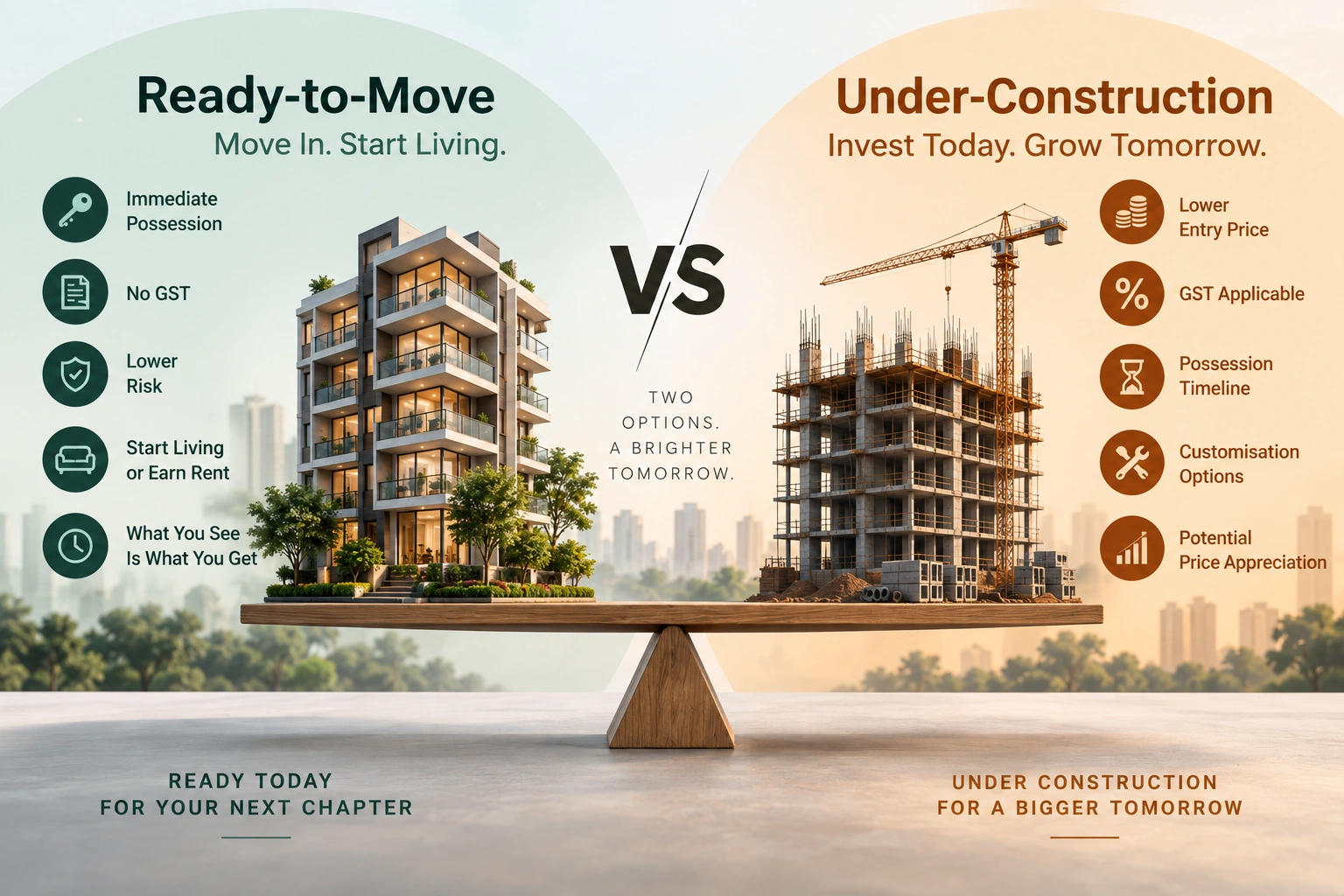
Under-construction properties are almost always priced lower than comparable ready-to-move homes in the same locality, sometimes by 10-20% or more. Developers price this way to attract early buyers and fund construction through instalments as the project progresses.
Ready-to-move properties carry a premium precisely because the uncertainty is gone — what you see is what you get, with no risk of delay or change in specifications.
Risk of Delay
This is where under-construction properties carry their biggest downside. Even with RERA's possession-timeline protections in place, delays still happen, whether due to funding issues, approval delays, or a developer simply overcommitting on delivery dates.
A ready-to-move property has no such risk. What's built is built — there's nothing left to go wrong on the construction timeline.
Taxation (GST)
Under-construction properties attract GST, typically around 5% for non-affordable housing and 1% for affordable housing segments, calculated on the property value (rates and slabs are revised periodically, so it's worth confirming the current rate before budgeting).
Ready-to-move properties, once the Occupancy Certificate has been issued, are exempt from GST entirely. This is one of the more overlooked cost differences buyers discover only after comparing final numbers.
Loan Disbursement & EMI Pattern
For under-construction properties, banks disburse the home loan in stages, tied to construction progress. During this period, you typically pay only "pre-EMI" — interest on the amount disbursed so far — while your full EMI begins only after possession.
For ready-to-move properties, the entire loan amount is disbursed upfront, and full EMI starts immediately. If you're currently paying rent, this means overlapping rent and EMI is avoided entirely with a ready-to-move purchase.
Customization & Specifications
Booking early in an under-construction project sometimes gives buyers the ability to request layout tweaks, choose flooring or fittings, or select a preferred unit position within the building — flexibility that's simply not available once a project is complete.
With ready-to-move homes, what's built is final. Any changes happen only after possession, at the buyer's own cost and effort.
A Practical Way to Decide
Rather than treating this as a purely financial decision, it helps to ask three questions honestly:
Do you need to move in within the next year? If yes, ready-to-move is the only realistic option — no under-construction project can guarantee that timeline with certainty.
Can you comfortably manage rent and pre-EMI simultaneously for a few years? If not, the lower entry price of an under-construction property may not actually save you money once you account for rent paid while waiting.
Is the specific project you're considering close to completion, or several years away? A near-completion under-construction project carries far less delay risk than one that's just launched, and often comes close to ready-to-move pricing anyway.
A Real-World Example
Consider two buyers with similar budgets. One books an under-construction flat priced 15% lower, planning to move in within a year based on the developer's promised timeline. The other buys a ready-to-move flat at full price but moves in the same month.
If the under-construction project gets delayed by two years — which isn't uncommon — the first buyer ends up paying rent plus pre-EMI for that entire period, potentially erasing much of the price advantage they started with. If the project is delivered on time, the math works out clearly in their favour instead. The outcome genuinely depends on execution risk, not just the sticker price.
Common Mistakes Buyers Make
A common mistake is comparing only the base price between the two options, without factoring in GST, potential rent-plus-pre-EMI overlap, or the interest cost of an extended pre-EMI period.
Another is assuming every under-construction project will face delays, or conversely, assuming none will — both are unrealistic. The developer's track record and the project's current construction stage matter far more than a blanket assumption either way.
Some buyers also underestimate how much flexibility matters to them personally. If a job relocation or family need means you must move within a fixed window, an attractive under-construction price becomes irrelevant if possession can't be guaranteed in time.
Expert Tip
If you're leaning toward an under-construction property, don't evaluate the price alone — check the project's current construction stage in person or through verified photos, confirm the RERA-registered possession date, and calculate your total cost including likely rent overlap and pre-EMI interest before comparing it against a ready-to-move alternative.
Frequently Asked Questions
Is it safer to buy a ready-to-move property than an under-construction one? Generally yes, since there's no construction or delivery risk involved. However, under-construction properties from developers with a strong, verifiable track record can still be a reasonable choice, especially at a lower price point.
Do under-construction properties always cost less than ready-to-move ones? Usually, yes, at the time of booking. But once you factor in GST, pre-EMI interest, and potential rent overlap during construction, the actual cost gap often narrows.
Is GST applicable on ready-to-move properties? No. GST applies only to under-construction properties. Ready-to-move properties are exempt once the Occupancy Certificate has been issued.
Can I get a home loan for an under-construction property? Yes, but the loan is disbursed in stages linked to construction milestones, and you pay pre-EMI (interest only) until possession, after which full EMI begins.
Which option is better for rental income? Ready-to-move properties allow you to start earning rental income immediately. Under-construction properties only start generating rental income after possession, which could be years away.
Final Thoughts
There isn't a universally better choice between ready-to-move and under-construction property — only a better choice for your specific timeline, budget, and risk tolerance. A lower price on paper can turn into a wash, or even a loss, if delays stretch out the wait. Equally, paying a premium for immediate possession may be entirely worth it if it saves you years of rent and uncertainty.
Before deciding, run the actual numbers for your situation — including GST, pre-EMI, and potential rent overlap — rather than comparing sticker prices alone. That's what separates a well-informed decision from a rushed one.