
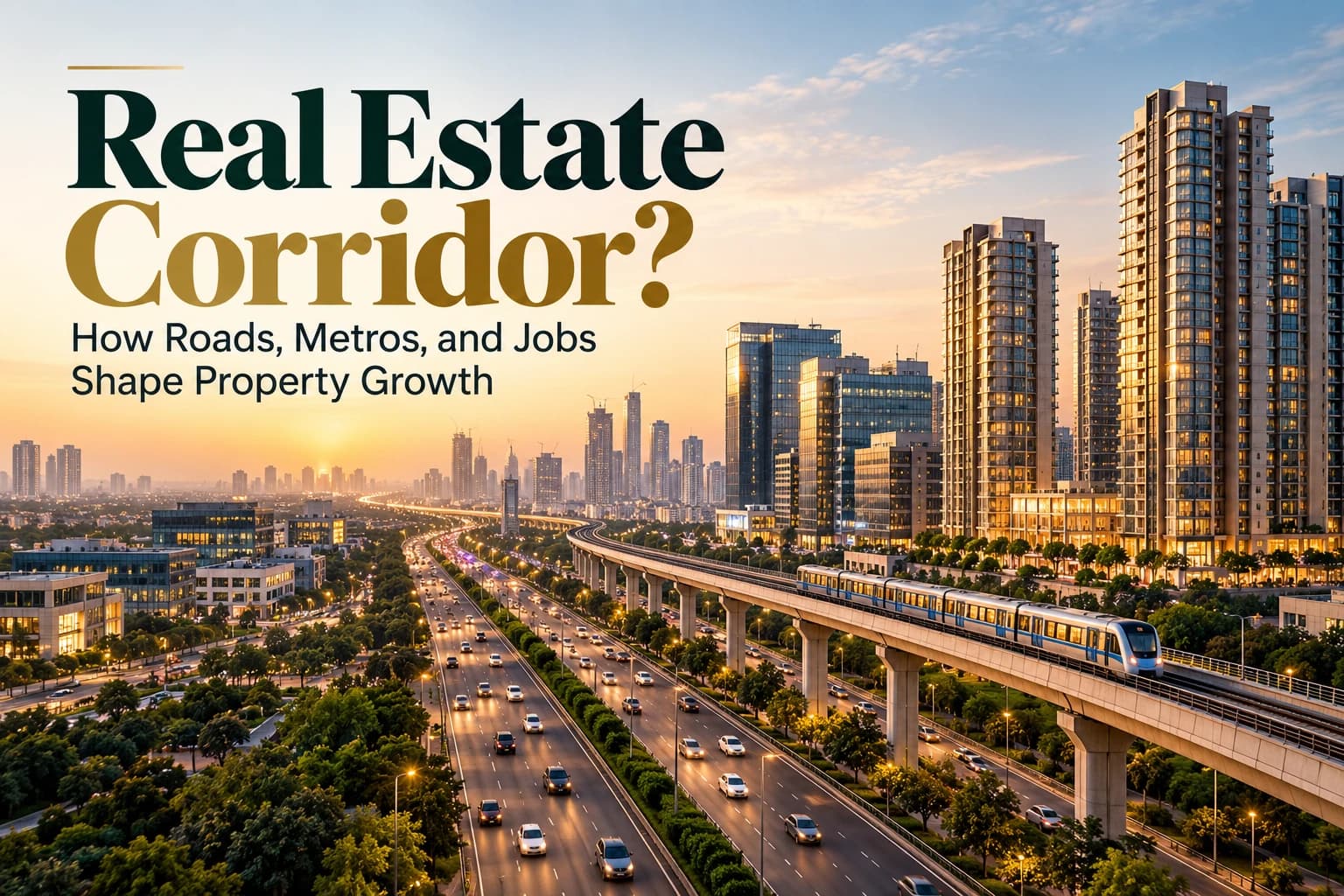
What Is a Real Estate Corridor? How Roads, Metros, and Jobs Shape Property Growth
Twenty years ago, much of what is now Golf Course Road in Gurgaon was farmland. Today it's one of the most expensive addresses in the NCR. The same story has played out along Sohna Road, the Noida Expressway, Bengaluru's Outer Ring Road, and dozens of other stretches across India. A road comes up, offices follow, homes follow the offices, and within a decade, prices look nothing like they used to.
Property experts have a name for these stretches: real estate corridors. If you're buying a home or investing in property, understanding how corridors work can help you spot where growth is likely to happen and where the hype is running ahead of reality.
What Is a Real Estate Corridor?
A real estate corridor is a stretch of land that develops along a major line of connectivity, such as an expressway, highway, arterial road, metro line, or railway route. Because it's easy to travel along, the area attracts housing, offices, retail, and social infrastructure like schools and hospitals, and property development concentrates along it.
In simple words, a corridor is where connectivity turns land into a place people want to live and work. The road or metro line is the spine, and the projects that come up on either side form the body of the corridor.
In Gurgaon alone, you'll hear buyers and brokers talk about the Dwarka Expressway corridor, the Golf Course Extension Road corridor, the Southern Peripheral Road (SPR) corridor, the Sohna Road corridor, and the stretch along NH-48. Each has its own character, price range, and stage of development.
Why Do Real Estate Corridors Develop?
Corridors don't appear by accident. A few forces usually work together.
Infrastructure development. A new expressway, flyover, or metro line cuts travel time and makes previously remote land accessible. This is often the first trigger.
Employment hubs. When offices, IT parks, or industrial zones come up along or near a road, people want to live close to work. Residential demand follows.
Government planning. In Haryana, the Gurugram Master Plan and DTCP zoning decide which areas are meant for residential, commercial, or industrial use. Land zoned for development along a planned road naturally becomes a corridor.
Social infrastructure. Schools, hospitals, malls, and markets make an area livable. Once these arrive, families feel comfortable moving in.
Land availability. Established city centres run out of space. Corridors on the edges offer larger land parcels at lower prices, which attracts developers.
What Are the Different Types of Real Estate Corridors?
Corridors can be grouped by what dominates them.
Residential corridors are mostly housing projects: apartments, builder floors, villas, and plotted developments. New Gurgaon, spread across sectors in the 70s to 90s, is a good example.
Commercial corridors are dominated by offices, retail, and hospitality. Golf Course Road and parts of the NH-48 stretch in Gurgaon have strong commercial activity.
Industrial corridors are built around manufacturing, logistics, and warehousing. The Delhi-Mumbai Industrial Corridor (DMIC) is a large national-level example, and areas along the KMP Expressway have seen logistics growth.
Mixed-use corridors combine homes, offices, shops, and entertainment. Many of today's fastest-growing corridors fall into this category, because people increasingly want to live, work, and shop within a short distance.
What Is the Difference Between an Established and an Emerging Corridor?
This distinction matters a lot for buyers and investors.
An established corridor has already developed. Roads are complete, offices are running, schools and hospitals are functional, and people live there. Prices are higher, but risks are lower, and rental demand is proven. Golf Course Road and Sohna Road's northern stretch are examples in Gurgaon.
An emerging corridor is still developing. The road may be newly built or under construction, many projects are still coming up, and social infrastructure is limited. Prices are lower, and the potential for capital appreciation is higher, but so are the risks. Delays in infrastructure, slow occupancy, and oversupply can all hold back returns.
Most buyers who made big gains in corridor investments bought in the emerging phase. Most who got stuck with stagnant properties also bought in the emerging phase. The difference usually came down to how solid the growth drivers were.
How Does a Real Estate Corridor Grow Over Time?
Corridors typically move through recognisable stages.
In the announcement stage, a road, metro line, or major project is announced. Land prices start rising on speculation, often faster than actual development.
In the construction stage, the infrastructure is being built, and developers launch projects. Buyers get lower launch prices but face the longest wait.
In the early occupancy stage, the first projects get delivered, some residents move in, and basic services start. Prices usually see a steady rise as the area becomes real, not just a promise.
In the maturity stage, the corridor is fully functional, with offices, retail, schools, and hospitals in place. Price growth slows, but rental yields and livability are strong.
Knowing which stage a corridor is in helps you set realistic expectations about returns and timelines.
Why Are Real Estate Corridors Important for Homebuyers?
Better connectivity means an easier daily life. Living along a well-connected corridor can cut your commute significantly and give you access to more job options.
Planned development. Corridors backed by a master plan tend to have wider roads, zoned green areas, and space for schools and hospitals.
Growing amenities. As a corridor matures, retail, healthcare, and entertainment options increase, often within a short drive.
Resale and rental demand. Properties along active corridors usually attract more buyers and tenants than those in isolated pockets.
Why Do Investors Track Real Estate Corridors?
For investors, corridors offer something every property investment needs: a visible reason for prices to rise. When you can point to a new expressway, an upcoming metro station, or a large office campus, the case for price appreciation becomes easier to judge.
Investors typically look at the pace of infrastructure work, the number of projects launched versus delivered, absorption rates, rental demand from nearby employment hubs, and how prices compare with established corridors nearby. A corridor priced well below a mature neighbour, with strong infrastructure under way, can offer good value. A corridor where prices have already jumped on announcements alone may have little room left.
What Are the Risks of Investing in a Real Estate Corridor?
Corridors aren't a guaranteed path to profit. The common risks are worth knowing.
Infrastructure delays. Expressways and metro lines often take years longer than promised. Dwarka Expressway, for instance, took well over a decade to become operational, and many early buyers waited a long time for returns.
Oversupply. When too many developers launch projects at once, supply can outpace demand, keeping prices flat and rentals weak.
Speculative pricing. Prices sometimes rise on news and hype rather than real development. If the promised growth doesn't arrive on time, prices can stagnate.
Project delivery risk. In emerging corridors, smaller or less experienced developers may struggle to deliver on time.
Incomplete social infrastructure. A flat on a great road is still hard to live in if the nearest school, hospital, or grocery store is far away.
How to Evaluate a Real Estate Corridor Before Buying
- Check the infrastructure status. Find out whether the road or metro line is complete, under construction, or only announced.
- Look at the master plan. Confirm the zoning of the land around the corridor, especially for green belts, commercial zones, and planned facilities.
- Track employment hubs. See whether offices, IT parks, or industrial areas are nearby or coming up.
- Count the supply. Look at how many projects have been launched and how many are actually delivered and occupied.
- Check developer track record. Prefer developers with a history of timely delivery, and verify RERA registration for every project.
- Visit at different times. Drive the corridor during rush hour and at night to get a real sense of traffic, safety, and activity.
- Compare prices with nearby corridors. This helps you judge whether current prices already reflect future growth.
The Bottom Line
A real estate corridor is a stretch of land that grows along a major road, expressway, or metro line, drawing homes, offices, and amenities along with it. Corridors are one of the clearest ways to understand where a city is heading. The best opportunities usually come from corridors with real infrastructure, genuine employment demand, and planned development, not just announcements. Look beyond the brochures, check what's actually on the ground, and choose a corridor based on how you'll live or what returns you realistically expect.
Frequently Asked Questions (FAQs)
1. What is a real estate corridor in simple words?
It's a stretch of land along a major road, expressway, or metro line where housing, offices, and other development concentrate because of good connectivity.
2. What are some popular real estate corridors in Gurgaon?
Well-known corridors include Dwarka Expressway, Golf Course Road, Golf Course Extension Road, Sohna Road, Southern Peripheral Road (SPR), and the NH-48 stretch.
3. What is the difference between an established and an emerging corridor?
An established corridor is already developed with functioning infrastructure and higher prices. An emerging corridor is still developing, with lower prices and higher potential but more risk.
4. Why do property prices rise along real estate corridors?
Better connectivity, new employment hubs, planned development, and growing amenities increase demand, which pushes prices up over time.
5. Is it better to invest in an emerging corridor?
It can offer higher returns, but it also carries risks like infrastructure delays and oversupply. It suits investors with a longer time horizon and higher risk tolerance.
6. What is an industrial corridor?
An industrial corridor is a stretch developed around manufacturing, logistics, and warehousing, often supported by highways, freight routes, and government planning.
7. How does a metro line create a real estate corridor?
A metro line cuts travel time and improves access, making nearby areas more attractive for homes, offices, and retail, which drives development along the route.
8. What are the risks of buying property in a new corridor?
Common risks include delays in roads or metro lines, too many projects coming up at once, speculative pricing, developer delivery issues, and limited social infrastructure.
9. How can I check if a corridor has real growth potential?
Look at infrastructure progress, nearby employment hubs, master plan zoning, supply versus occupancy, developer track records, and price comparisons with mature areas.
10. Do real estate corridors offer good rental yields?
Mature corridors near employment hubs usually offer steady rental demand. Emerging corridors may have lower rental demand until offices and amenities come up.