
Sale Deed vs Agreement to Sell — The Difference Buyers Often Confuse
One document promises a sale. The other completes it. Here's why treating them as the same thing is one of the costliest misunderstandings a property buyer can make.
Introduction
A buyer once told us he'd "bought" his flat two years ago. He had paid the full amount, held a signed and notarized document, and had even moved in. But when he tried to sell it, he discovered the property was still legally registered in the previous owner's name.
What he was holding was an Agreement to Sell. What he needed, and never got, was a Sale Deed.
This mix-up is more common than it should be, largely because both documents look similar, get signed around the same time, and use overlapping language. But legally, they do very different jobs — and only one of them actually makes you the owner.
What Is an Agreement to Sell?
An Agreement to Sell is a document in which the seller agrees to transfer ownership of a property to the buyer, at a future date, once certain conditions are fulfilled — typically full payment, clearance of dues, or completion of paperwork.
It sets out the terms of the transaction: the price, the payment schedule, the timeline for possession, and the obligations of both parties. But here's the part buyers frequently miss —
An Agreement to Sell does not, by itself, transfer ownership.
It's a promise to sell, backed by legally enforceable terms. If either party fails to honor it, the other can seek legal remedy — including specific performance, which compels the sale to go through. But until the actual transfer happens, the buyer has a contractual right, not ownership.
What Is a Sale Deed?
A Sale Deed, sometimes called a Conveyance Deed, is the document that actually transfers ownership from the seller to the buyer. It is executed once the terms of the Agreement to Sell have been fulfilled, and it must be registered with the sub-registrar's office to be legally valid.
Once the Sale Deed is registered, the buyer becomes the legal owner of the property, with full rights to possess, use, sell, or transfer it further.
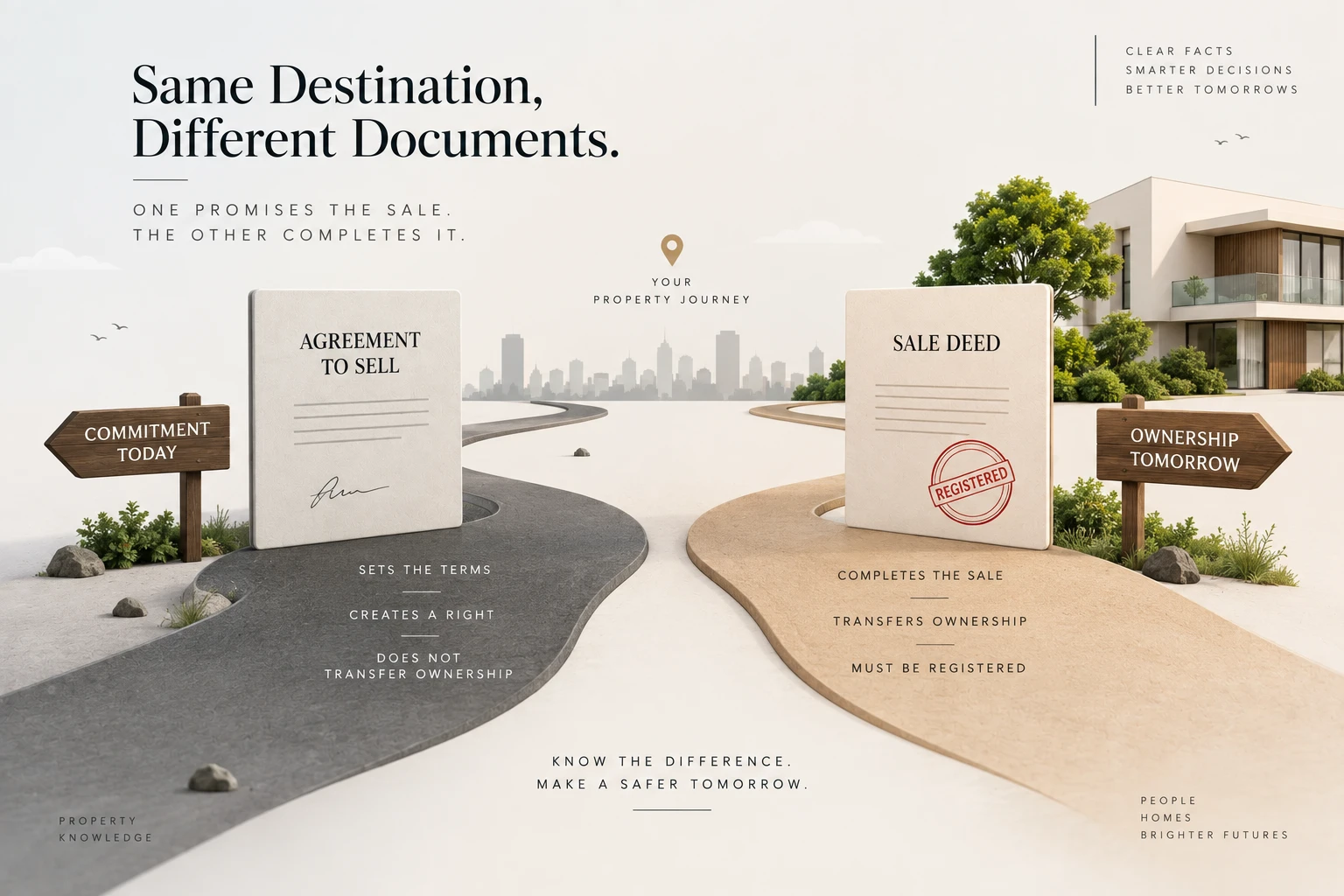
In simple terms: The Agreement to Sell is the promise. The Sale Deed is the delivery. You don't legally own a property until the Sale Deed is registered in your name.
Why This Distinction Actually Matters
This isn't just a technical formality — it has real consequences for buyers.
- Ownership rights: Only a registered Sale Deed gives you legal title. An Agreement to Sell, however detailed, does not.
- Resale: You cannot resell a property based on an Agreement to Sell alone. Any future sale requires the original Sale Deed in your name.
- Loan eligibility: Most banks require a registered Sale Deed (or at least confirmation that one will follow) before disbursing a home loan, since the property serves as collateral.
- Legal disputes: If a seller backs out after an Agreement to Sell, the buyer's recourse is a civil suit for specific performance — a process that can take years, unlike the immediate protection a registered Sale Deed provides.
- Inheritance and succession: Only a person named in a registered Sale Deed is recognized as the legal owner for the purposes of inheritance.
Sale Deed vs Agreement to Sell
Legal Effect An Agreement to Sell is a promise to transfer ownership. A Sale Deed is the actual transfer of ownership.
Registration An Agreement to Sell isn't always mandatory to register. A Sale Deed, on the other hand, must be registered under law.
Ownership Under an Agreement to Sell, ownership remains with the seller. Once a Sale Deed is executed, ownership passes to the buyer.
Enforceability An Agreement to Sell is enforceable as a contract. A Sale Deed serves as legal proof of title.
Stage of Transaction The Agreement to Sell is executed before the sale is complete. The Sale Deed is executed to complete the sale.
Use in Resale or Loans An Agreement to Sell cannot be used alone for resale or loan purposes. A Sale Deed is the required document in both cases.
A Real-World Example
Consider a buyer who signs an Agreement to Sell for an under-construction flat, paying 20% upfront with the balance linked to construction milestones. At this stage, the buyer has a contractual right to the flat once payments and conditions are met — but the builder still legally owns it.
Only once the flat is complete, the full payment is made, and the Sale Deed is executed and registered does the buyer actually become the legal owner. Until that point, referring to the flat as "bought" is accurate in conversation, but not in law.
Common Mistakes Buyers Make
A frequent mistake is treating a notarized Agreement to Sell as equivalent to ownership, particularly in resale transactions where the seller assures the buyer that "registration can happen later."
Another common error is paying the full amount based solely on an Agreement to Sell, without insisting on a timeline for the Sale Deed's execution and registration.
Some buyers also assume that possession of the property — having the keys and living in it — is proof of ownership. It isn't. Possession without a registered Sale Deed leaves the buyer legally vulnerable, especially in disputes or inheritance claims.
Buyers occasionally also overlook that stamp duty and registration charges apply specifically to the Sale Deed, not the Agreement to Sell, and budget incorrectly as a result.
Expert Tip
Before making any substantial payment, ask directly for a clear timeline on when the Sale Deed will be executed and registered — and get it in writing as part of the Agreement to Sell itself. If a seller is reluctant to commit to a registration timeline, treat that as a signal to investigate further before proceeding.
Frequently Asked Questions
Is an Agreement to Sell legally binding? Yes, it's a legally enforceable contract, but it doesn't transfer ownership. It only obligates both parties to complete the sale under the agreed terms.
Can I sell my property if I only have an Agreement to Sell? No. You need a registered Sale Deed in your name to legally transfer ownership to another buyer.
Do I have to register an Agreement to Sell? Registration of an Agreement to Sell is not mandatory in most states, though registering it can strengthen your legal position. A Sale Deed, however, must be registered.
What happens if the seller refuses to execute the Sale Deed after signing an Agreement to Sell? The buyer can approach a civil court and seek specific performance of the contract, compelling the seller to complete the sale, or claim damages instead.
Is stamp duty paid on the Agreement to Sell or the Sale Deed? Stamp duty and registration charges are paid at the time of executing and registering the Sale Deed, which is what completes the ownership transfer.
Final Thoughts
An Agreement to Sell and a Sale Deed are two different stages of the same transaction, not interchangeable paperwork. One commits both parties to a future sale; the other actually makes it happen.
Before you consider a property "bought," check which of the two documents you're actually holding. If it's only an Agreement to Sell, your ownership isn't complete yet — and knowing that early can save you from a legal and financial mess down the line.