
What Is RERA? Meaning, Objectives & The Buyer Protections It Actually Gives You
Understand what RERA means, why it was introduced, and the real protections it offers homebuyers — from escrow accounts to delivery timelines — before you sign on the dotted line.
Introduction
A few years ago, buying an under-construction flat in India was as much a matter of faith as it was a financial decision. Possession dates slipped by years, brochures promised amenities that never materialised, and buyers had little recourse beyond a strongly worded legal notice.
RERA changed that equation.
If you're evaluating a new project today, you've probably come across the term "RERA-registered" in almost every listing and brochure. But most buyers use the word without really knowing what it guarantees — or where its protection stops.
Here's a clear, practical breakdown of what RERA actually means for you as a buyer.
What Is RERA? (Meaning & Full Form)
RERA stands for the Real Estate (Regulation and Development) Act, 2016 — a central law enacted by the Indian government to regulate the real estate sector and protect homebuyers from unfair practices.
Before RERA, real estate transactions were governed loosely by state-level laws, builder-buyer agreements, and whatever terms a developer chose to include in the fine print. RERA introduced a uniform framework that every state had to adopt, along with a dedicated regulatory authority to enforce it.
Each state has its own Real Estate Regulatory Authority (RERA) — for instance, HRERA in Haryana or MahaRERA in Maharashtra — along with an Appellate Tribunal where buyers can escalate disputes if they're not satisfied with the authority's decision.
In simple terms: RERA is the law that requires developers to register their projects, disclose accurate information, and be held accountable if they fail to deliver on what was promised.
Why Was RERA Introduced?
Before 2016, homebuyers routinely faced a set of recurring problems:
- Projects delayed by years with no compensation
- Sale based on super built-up area, with no clarity on actual carpet area
- Funds collected for one project quietly diverted to another
- Approvals and layout changes made without informing buyers
- No independent authority to approach for grievances
RERA was designed to close each of these gaps by making developers legally accountable, not just contractually accountable.
The Core Buyer Protections Under RERA
This is the part that matters most in practice. Here's what RERA actually secures for you as a buyer.
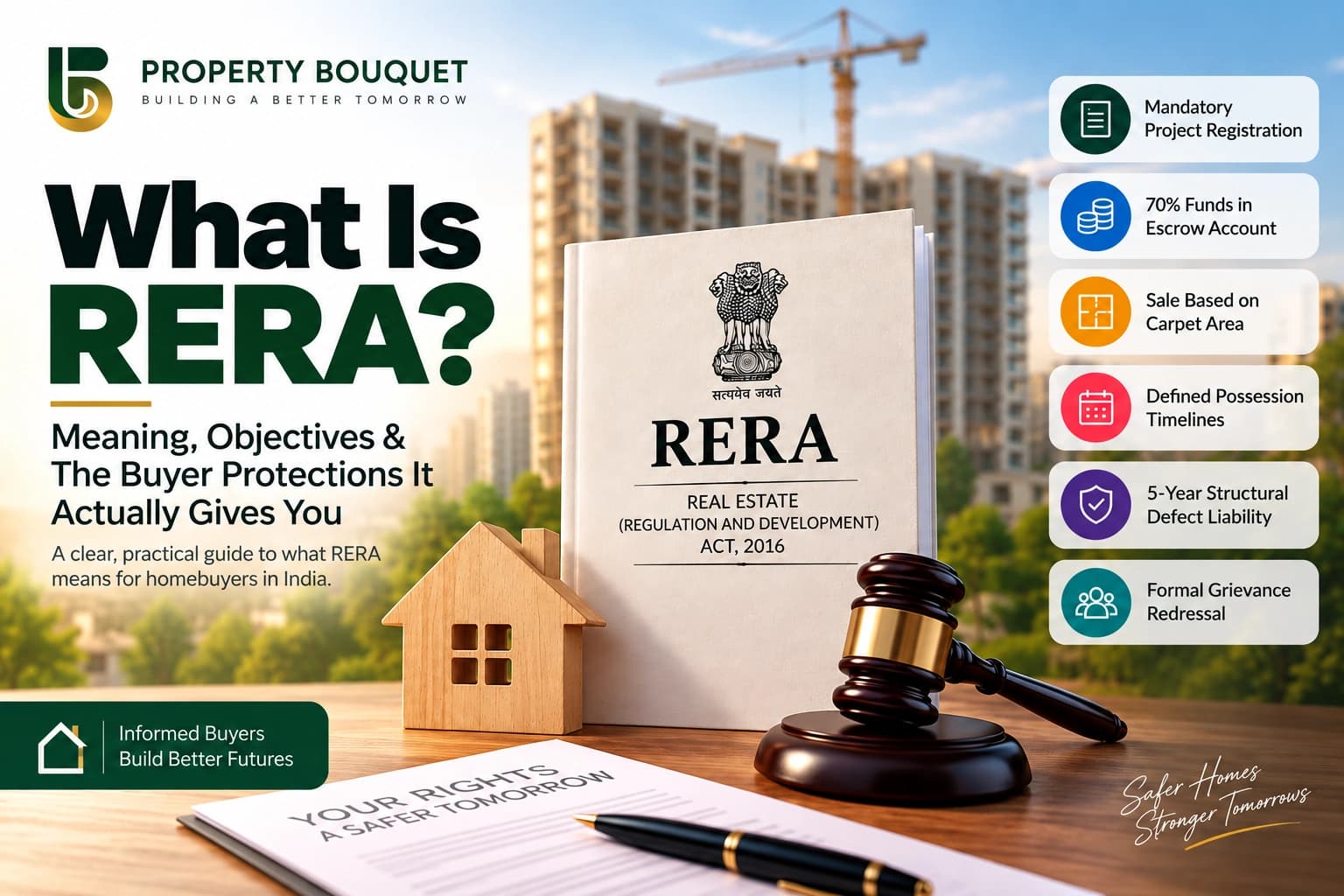
1. Mandatory Project Registration Any project larger than 500 square metres, or with more than eight units, must be registered with the state RERA authority before it can be advertised or sold. Registration details, layout plans, and approvals are published on the RERA website for anyone to verify.
2. 70% Funds in an Escrow Account Developers must deposit at least 70% of the money collected from buyers into a separate escrow account, to be used only for the construction and land cost of that specific project. This was introduced specifically to stop developers from diverting buyer funds to other projects.
3. Sale Based on Carpet Area, Not Super Built-Up Area RERA mandates that developers sell and price apartments based on carpet area, using a standard definition across the country. This alone has made comparing two projects far more transparent than it used to be.
4. Defined Possession Timelines with Penalties for Delay The agreed possession date must be stated clearly in the buyer's agreement. If the developer delays possession, they are liable to pay interest to the buyer for every month of delay — the buyer isn't left simply waiting.
5. Structural Defect Liability If any structural defect is reported within five years of possession, the developer is obligated to repair it at no cost to the buyer. This protection continues well after the sale is complete.
6. No Changes Without Buyer Consent Once a project is registered, the developer cannot alter the sanctioned plans, layout, or specifications without the written consent of at least two-thirds of the buyers in that project.
7. A Formal Grievance Redressal Mechanism If a developer violates any of the above, buyers can file a complaint directly with the state RERA authority, and appeal further with the Real Estate Appellate Tribunal if needed — without necessarily having to go through lengthy civil court proceedings.
RERA vs the Pre-RERA Era
The shift RERA brought about is easiest to see side by side, one aspect at a time.
Project Registration Before RERA, registering a project wasn't mandatory. Today, registration is compulsory, and every detail is publicly disclosed on the RERA website.
Sale Area Earlier, developers often sold and priced homes based on super built-up area. Now, carpet area is the standardised basis for both pricing and comparison.
Buyer Funds Previously, money collected from buyers could be used across different projects. Today, 70% of those funds must be ring-fenced in an escrow account for that specific project.
Delay in Possession There used to be no defined penalty for delayed possession. Now, developers are liable to pay interest to the buyer for every month of delay.
Structural Defects Earlier, any structural issue after possession was the buyer's own cost to fix. Now, the developer remains liable for five years after possession.
Dispute Resolution Before RERA, buyers had to rely on slow-moving civil courts. Today, a dedicated RERA authority and appellate tribunal exist specifically for these disputes
A Real-World Example
Consider two buyers evaluating similar 3BHK projects. One project is registered with the state RERA authority, its escrow account and layout approvals are visible on the RERA portal, and the buyer's agreement specifies a possession date with a delay clause. The other project's developer says registration is "in process" and asks the buyer to sign based on the brochure alone.
On paper, the two projects may look comparable. In practice, only one of them offers any real recourse if things go wrong.
Common Mistakes Buyers Make
Many buyers check whether a project is RERA-registered but stop there, without actually looking up the registration number on the state RERA website to confirm approvals, timelines, and any past complaints against the developer.
Another frequent oversight is assuming RERA covers everything — it doesn't extend to resale properties, and its protections are strongest for registered under-construction projects, not completed or resale transactions.
Some buyers also skip reading the buyer's agreement closely, even though RERA's protections are only enforceable if the agreement reflects them correctly.
Expert Tip
Before booking any under-construction property, look up the project's RERA registration number and verify it directly on your state's official RERA website. This single step tells you the promised possession date, the sanctioned layout, and whether any complaints have been filed against the project — information no brochure will volunteer.
Frequently Asked Questions
What is the full form of RERA? RERA stands for the Real Estate (Regulation and Development) Act, 2016.
Is RERA registration mandatory for all real estate projects? Yes, for any project larger than 500 square metres or with more than eight units, registration with the state RERA authority is mandatory before it can be advertised or sold.
What happens if a developer delays possession under RERA? The developer becomes liable to pay interest to the buyer for every month of delay, as specified in the buyer's agreement.
Does RERA apply to resale properties? No, RERA's protections are strongest for registered under-construction projects. Resale and completed properties fall largely outside its direct scope.
How can a buyer file a complaint under RERA? Buyers can file a complaint directly with their state's Real Estate Regulatory Authority, and appeal further with the Real Estate Appellate Tribunal if unsatisfied with the outcome.
Final Thoughts
RERA didn't just introduce paperwork — it shifted the balance of power between developers and buyers in a market that badly needed it. Understanding what it actually guarantees, and where its protections end, puts you in a far stronger position to evaluate a project on facts rather than assurances.
Before you finalise any property, verify its RERA registration, read the buyer's agreement in full, and don't hesitate to ask the developer direct questions about escrow accounts and possession timelines. That single habit separates an informed buyer from a hopeful one.