
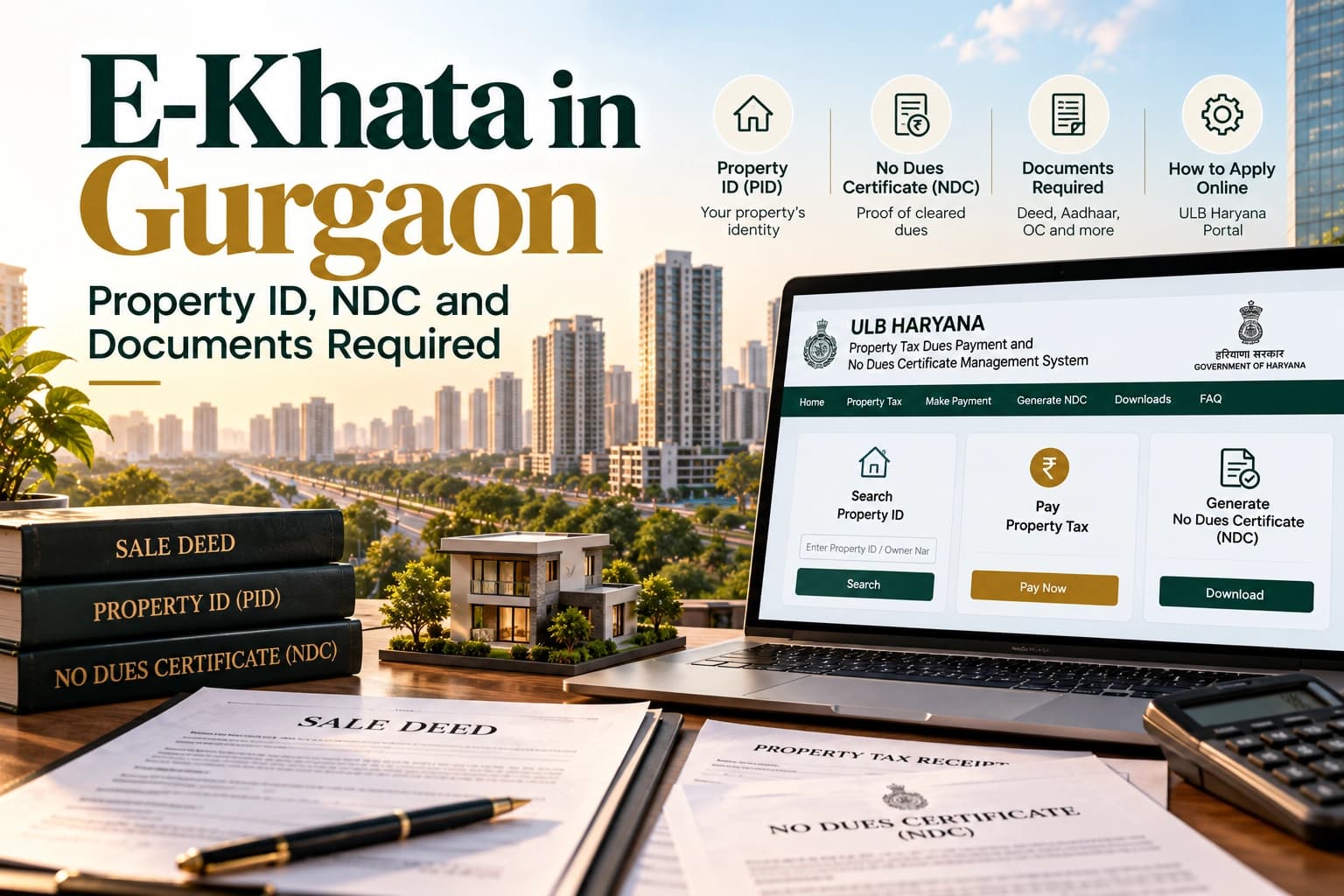
E-Khata in Gurgaon: What Buyers and Owners Need to Know
People moving from Bengaluru, or reading about property online, often ask for the e-Khata in Gurgaon. It's a fair question, since Bengaluru now won't register a sale without one. But Haryana doesn't use the word "Khata" for urban property records. In Gurugram, the same job is done by two things: your Property ID (PID) and the No Dues Certificate (NDC). Get these right and your sale, loan or transfer moves smoothly. Get them wrong and the sub-registrar may simply refuse to register your deed.
Is There an E-Khata in Gurgaon?
No, not by that name. E-Khata is the digital property account used in Karnataka. In Haryana, urban property records are maintained by the Urban Local Bodies Department and, in Gurugram, by the Municipal Corporation of Gurugram (MCG), through the ULB Haryana Property Tax and NDC portal (property.ulbharyana.gov.in).
Here's how the two systems compare:
- Property ID (PID) is the unique identification number given to every property in municipal limits. It records the owner's name, property type, area, address and tax details, just like a Khata does.
- No Dues Certificate (NDC) confirms that all municipal dues, including property tax, on that property have been paid. It's generated from the same portal using the PID.
Together, the PID and NDC are Gurgaon's closest equivalent of an e-Khata.
Why Property ID and NDC Matter in Gurgaon
Under Haryana's municipal laws, a document for the sale, transfer, lease or gift of a property in municipal limits cannot be registered unless it is accompanied by a No Dues Certificate confirming that all municipal dues have been paid. And you can't generate an NDC without an active, correct Property ID.
That makes the PID and NDC essential for:
- Property registration at the sub-registrar's office
- Home loans and loans against property, since banks ask for the latest tax receipt or NDC
- Paying property tax to the MCG
- Resale, as buyers and their lawyers check that the PID matches the title documents
- Building plan approvals and utility services from the municipal corporation
Because municipal dues stay attached to the property, not the person, a buyer who skips this check can end up paying the seller's old dues.
Municipal Records vs Revenue Records in Gurgaon
Gurgaon property sits in one of two record systems, and it helps to know which one applies to yours.
Municipal records (PID and NDC) cover flats, builder floors, houses and plots within MCG limits, including HSVP sectors and licensed colonies. Property tax and NDC are handled here.
Revenue records (Jamabandi and Intkal) cover agricultural and rural land, maintained by the revenue department. Here, the owner's name is updated through mutation of land, known locally as Intkal, and recorded in the Jamabandi.
In addition, HSVP plots and developer projects have their own transfer records, such as HSVP's re-allotment or the developer's endorsement for flats. A careful buyer checks all the records that apply, not just one.
Documents Required for Property ID in Gurgaon
Keep these ready before you create, self-certify or update your Property ID on the ULB Haryana portal. Scans should be clear and legible.
Ownership Documents
- Registered sale deed or conveyance deed, or another registered ownership deed such as a gift, transfer or release deed
- Allotment letter and possession letter, for HSVP plots or builder flats where the conveyance deed is still pending
- Occupation Certificate (OC) of the building, where applicable
Owner Details
- Aadhaar card or other identity proof of every owner
- Mobile number and email ID for portal registration and OTPs
- Haryana's Parivar Pehchan Patra (Family ID), if the portal asks for it
Property Details
- Property address with plot, flat or house number, sector or colony
- Plot area and covered area, matching the deed and approved plan
- Property type and use, such as residential, commercial or mixed
- Photograph of the property
- Electricity bill or water connection details, as supporting address proof
- Previous property tax receipts, if any
Documents Required for NDC and Special Cases
For a No Dues Certificate (NDC)
- An active, self-certified Property ID
- Payment of all pending property tax and other municipal dues
- The registered mobile number for OTP verification
For Specific Situations
- Transfer after a resale purchase: the registered sale deed in the buyer's name, the seller's NDC used at registration, and the buyer's identity proof
- Inheritance: death certificate of the previous owner, a legal heir or succession certificate or registered will, and no-objection affidavits from other heirs where required
- Split Property ID, when a plot or building is divided into separate units such as builder floors: the main Property ID, the deed for each unit and the approved plan
- Correction of PID details such as name, area or address: the correct ownership document and identity proof, plus any supporting NOC
- NRI owners: scanned documents with an overseas mobile number and email for portal registration, or a representative through a power of attorney
How to Get Your Property ID and NDC Online in Gurgaon
The process runs on the ULB Haryana Property Tax Dues Payment and No Dues Certificate Management System portal:
- Register on the portal with your mobile number and basic details
- Search for your Property ID by colony, plot number, eight-character Property ID, old Property ID, owner name or mobile number
- Self-certify your Property ID by checking the details and confirming them, or raise a correction request with documents if something is wrong
- Create a new Property ID if your property doesn't have one, by entering the details and uploading the documents
- Pay all dues online under the "Make Payment/Generate NDC" option
- Generate and download the NDC once dues are cleared
If the online record is wrong or missing, the MCG's property tax office can help with corrections.
Fees, Timeline and NDC Validity
Creating or self-certifying a Property ID on the portal doesn't involve a large fee. The main cost is clearing any pending property tax, interest and other municipal dues before the NDC is issued.
Once dues are cleared, the NDC can usually be downloaded right away. Corrections, new PIDs and split IDs take longer, since they need verification by the municipal office.
An NDC is valid only for a limited period, so get it as close to your registration date as possible. Many buyers in Gurgaon re-check the NDC status just before the registry to make sure nothing new has been added.
Common Mistakes That Delay Registration in Gurgaon
- Name mismatches between the deed, Aadhaar and Property ID
- Wrong plot or covered area recorded in the PID
- Property ID not self-certified, so the NDC can't be generated
- Old dues from previous owners that were never cleared
- One PID for several floors, when each builder floor needs its own split ID
- Outdated NDC, downloaded weeks before the registry
Quick Checklist Before You Buy or Sell
- The Property ID shows the seller's name and the correct area
- All property tax and municipal dues are paid
- A fresh NDC is generated close to the registration date
- Builder floors have separate split IDs
- For agricultural land, the Jamabandi and mutation records match the seller's title
- After buying, update the Property ID to your name
Final Thoughts
Gurgaon may not have an e-Khata, but it has something that works the same way. Your Property ID is your property's identity in the municipal system, and the No Dues Certificate proves it's free of municipal dues. Check both before you buy, keep your documents consistent, and update the PID in your name once the deal is done. That small effort keeps your registry, loan and future resale on track.