What Are Residential to Commercial Conversion Charges? A Property Owner's Guide
Drive through any older market road in Gurgaon or Delhi and you'll see it everywhere: a house with a boutique on the ground floor, a clinic in the front room, an office where a family once lived. Many owners assume that since they own the property, they can use it however they like. They can't. Using a home for business usually needs permission, and that permission comes at a price. Those fees are called residential to commercial conversion charges, and ignoring them can lead to penalties or even sealing.
What Is Residential to Commercial Conversion?
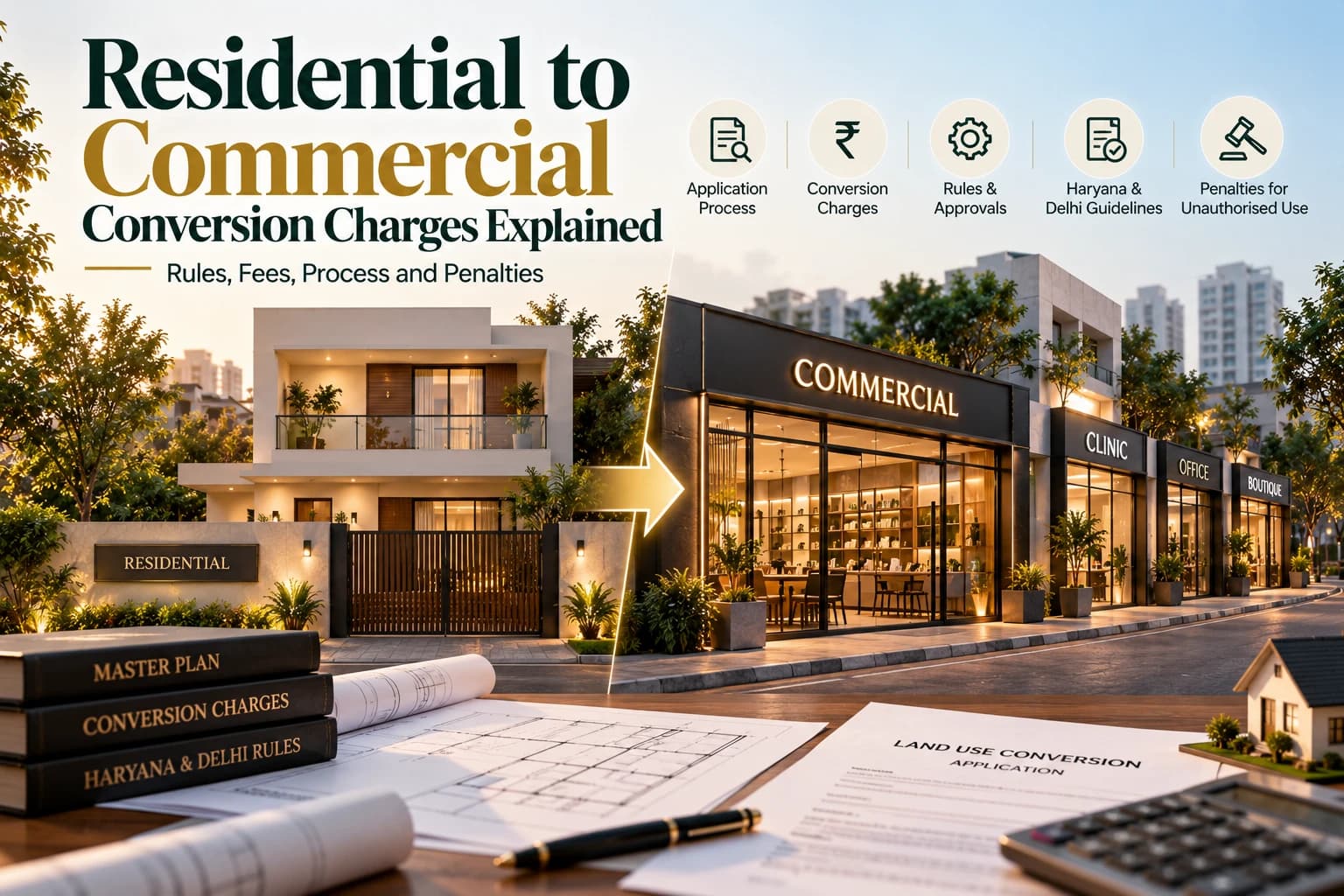
Every plot in a planned city has a permitted land use fixed by the master plan or the scheme it belongs to, such as residential, commercial, industrial or institutional. Residential to commercial conversion is the legal process of changing that permitted use so a residential plot or building can be used, fully or partly, for business.
The authority grants this permission only after the owner pays the prescribed conversion charges and meets conditions on road width, parking, floor area and the type of activity allowed.
For agricultural or undeveloped land, the equivalent step is a Change of Land Use (CLU) permission. For an existing residential plot in a city, it's usually called conversion or mixed land use permission.
Why Do Owners Convert Residential Property to Commercial?
The reasons are mostly financial:
- Higher rental income, since shops and offices on busy roads often earn far more rent than homes
- Higher property value, as legally converted commercial premises usually command a premium
- Running a business from home, such as a clinic, coaching centre, salon or small office
- Changing neighbourhoods, where a once-quiet residential road has turned into a busy market street
What Counts as Commercial Use?
Commercial use generally covers retail shops, showrooms, offices, banks, restaurants, guest houses, coaching centres, salons and similar businesses. Some authorities treat limited professional activity, such as a doctor's clinic or an architect's or lawyer's office run by the resident, more leniently than full commercial use. Polluting or nuisance activities like bars, pubs and liquor shops are usually not allowed in residential areas at all.
What Charges Are Involved in Conversion?
The total cost of conversion is rarely a single fee. Depending on the city and policy, owners may have to pay:
- Scrutiny fee, for processing the application
- Conversion charges, the main fee for changing the permitted use, usually calculated per square metre of plot or floor area
- Development charges, towards upgrading local infrastructure
- Parking charges, especially where commercial use will increase vehicle traffic
- Regularisation or penalty charges, if the property is already being used commercially without permission
- Higher property tax, since commercial properties are taxed at a higher rate than residential ones
- Commercial utility tariffs, as electricity and water connections may need to be switched to commercial rates
Residential to Commercial Conversion in Haryana and Gurgaon
In Haryana, the rules depend on who developed the area. That's the first thing every owner should check.
Municipal Areas: Haryana Municipal Urban Built-Plan Reform Policy, 2023
In October 2023, Haryana announced the Haryana Municipal Urban Built-Plan Reform Policy, 2023, allowing residential plots in long-established planned schemes within core municipal areas to be converted to commercial use. Under this policy, owners pay:
- A scrutiny fee of ₹10 per square metre
- Conversion charges as notified by the Town and Country Planning Department
- Development charges of 5% of the commercial collector rate per square metre
The plot's FAR, ground coverage and height remain the same as in the original residential scheme. The Municipal Corporation of Gurugram (MCG) handles these applications for eligible areas in the city.
HSVP Sectors and Licensed Colonies
The 2023 policy does not apply to sectors developed by HSVP (formerly HUDA), the Housing Board, HSIIDC, or areas governed by the Town and Country Planning Department, which includes most private licensed colonies in Gurgaon. These areas follow their own policies. For example, HSVP rules require the competent authority's permission even for running a professional consultancy from a residential plot, and Haryana's guest house policy charges 50% of commercial conversion charges on eligible residential plots.
If you own a plot in an HSVP sector or a DLF, Sushant Lok or similar licensed colony, check your allotment terms and the specific policy that applies to your area before using it commercially.
Residential to Commercial Conversion in Delhi
Delhi follows the mixed land use model under the Master Plan for Delhi. Commercial use of a residential property is allowed only on notified mixed-use or commercial streets, and only after paying one-time conversion charges at the rates notified for that colony, along with registration and parking charges where applicable.
A few points every Delhi owner should know:
- On mixed-use streets, commercial activity is generally limited to the ground floor, with upper floors staying residential
- In shop-cum-residence plots, upper floors can be converted to commercial use after paying the applicable charges
- Liquor shops, bars, discos, pubs and clubs are not allowed in residential premises under mixed use
- Money collected through conversion and parking charges goes into a dedicated fund for local infrastructure such as parking, public toilets and water supply
If your street isn't notified, no amount of payment will make commercial use legal.
How Are Conversion Charges Calculated?
There's no single national formula. Conversion charges depend on:
- Location and zone, with prime urban areas costing far more than smaller towns
- Plot size or floor area being converted, usually charged per square metre
- Collector rate or circle rate of the area, which many policies use as the base for development charges
- Type of commercial activity, since retail, offices, guest houses and hotels are often charged differently
- Road width and frontage, as properties on wider or arterial roads may attract higher charges
- Whether it's a fresh conversion or regularisation, as regularising existing unauthorised use often costs more
To give a sense of scale, when Haryana opened conversion in municipal areas in 2018, the fresh conversion charge in the Gurugram and Faridabad municipal corporations was set at ₹7,000 per square metre, and regularisation of existing buildings at ₹7,662 per square metre. Rates are revised from time to time, so always confirm the current notified rate with the authority before you plan your budget.
A simple way to estimate: multiply the area to be converted by the notified per-square-metre conversion rate, then add scrutiny fees, development charges and any parking or penalty charges.
How to Apply for Residential to Commercial Conversion
While the exact steps vary by authority, the typical process looks like this:
- Check eligibility, including whether your area, road and plot fall under a conversion policy or notified mixed-use street
- Gather documents and get the plans prepared by an architect if any changes are needed
- Apply online or offline to the relevant authority, such as the municipal corporation, HSVP, DTCP or the local body
- Pay the scrutiny fee at the time of applying
- Site inspection and scrutiny are carried out by the authority
- Pay conversion and other charges once a demand is raised
- Receive the conversion permission, and update property tax and utility records to commercial
Documents Usually Required
- Proof of ownership, such as the sale deed, conveyance deed or allotment letter
- Approved building plan and occupation certificate, where applicable
- Site plan showing the area proposed for conversion
- Latest property tax receipts and no-dues certificates
- Identity proof of the owner
- NOCs from fire and other departments, depending on the activity and size
- An affidavit or undertaking in the prescribed format
What Happens If You Use a Residential Property Commercially Without Permission?
Unauthorised commercial use of a residential property is a violation of building and land-use rules, and the consequences can be serious:
- Show-cause notices and penalty charges from the authority
- Sealing of the premises, a measure Delhi and Gurgaon authorities have used repeatedly
- Resumption or cancellation of the plot in some HSVP and licensed-area cases
- Back-dated commercial property tax and utility charges
- Difficulty selling or getting a loan, since buyers and banks check that the use matches approvals
In many cases, regularisation is possible by paying conversion charges plus penalties, but only if the area is eligible under a current policy.
Things to Check Before Converting or Buying a Converted Property
- Which authority governs your area: the municipal corporation, HSVP, DTCP or a licensed colony
- Whether your area or street is eligible for conversion under a current policy
- The current notified conversion rate, plus every additional charge
- Whether the expected rental income justifies the total conversion cost and higher property tax
- For a resale purchase, the conversion permission letter and proof that all charges were paid
- That unpaid conversion charges or penalties aren't pending on the property, since they can pass to the new owner
- RWA or society rules, which may restrict commercial activity even where the law allows it
Final Thoughts
Converting a residential property to commercial use can unlock real value, but only when it's done legally. Residential to commercial conversion charges are the price of that legitimacy. Before you open a shop, rent out a floor as an office or buy a "commercial" house, find out which authority governs the property, confirm that conversion is allowed, and get every charge in writing. A few lakh spent on proper permission is far cheaper than a sealed property.