What Is an RWA? A Buyer's Guide to Resident Welfare Associations
Buy a flat in any Gurgaon society and, sooner or later, you'll hear about "the RWA". It decides how your maintenance money is spent, who guards the gate, when the pool opens and what happens when the lift breaks down. Yet most buyers don't think about the RWA until something goes wrong. Understanding how it works, and who really controls it, is one of the smartest checks you can make before and after you buy.
What Is the RWA Full Form in Real Estate?
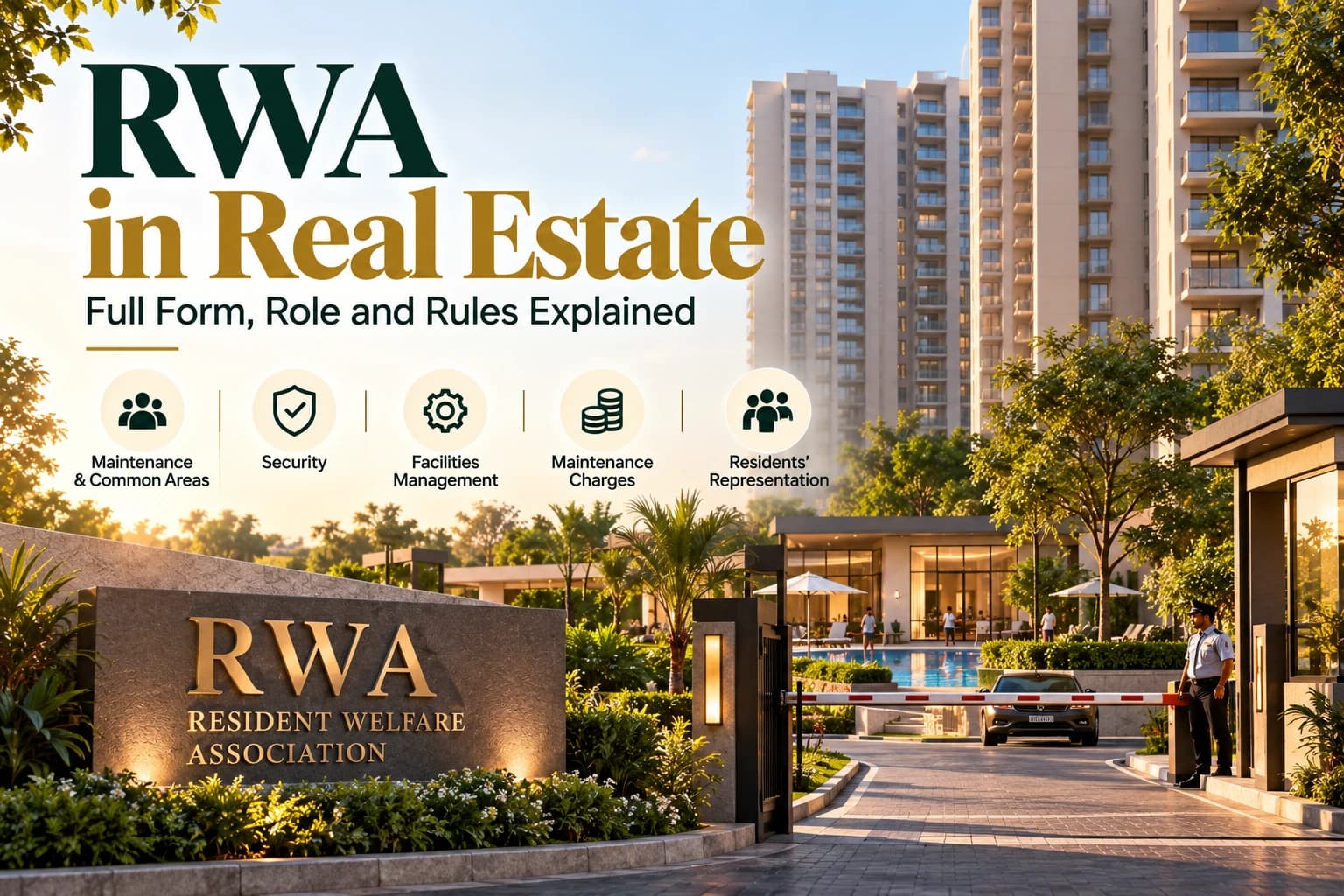
The RWA full form is Resident Welfare Association. It is a registered body formed by the residents or owners of a housing society, apartment complex, gated colony or residential sector to manage common facilities and represent residents' interests.
In simple terms, the RWA meaning is this: it is the residents' own management body. Once the builder steps back, the RWA becomes the voice of the community, dealing with maintenance, security, common areas, and local authorities such as the municipal corporation, the electricity department and the police.
RWAs exist in both apartment societies and plotted colonies. In a high-rise society, the RWA typically manages towers, lifts, clubhouses and common areas. In a plotted sector or colony, it usually focuses on security, parks, roads and coordination with civic bodies.
What Does an RWA Do? Key Roles and Responsibilities
A well-run RWA handles much of what makes a society liveable:
- Maintenance of common areas such as lobbies, lifts, corridors, gardens, parking and the clubhouse
- Collecting maintenance charges from residents and managing the society's funds
- Appointing and supervising vendors like the facility management agency, security guards and housekeeping staff
- Managing utilities, including water supply, DG power backup, sewage treatment and waste management
- Framing society rules on parking, pets, renovations, tenant entry and use of amenities
- Resolving disputes between residents
- Dealing with the builder on pending works, defects, and handover of maintenance and funds
- Representing residents before the municipal corporation, police, DTCP, RERA and other authorities
- Organising community events and festivals that build a sense of neighbourhood
The RWA's decisions directly affect your monthly costs, your safety and the resale value of your home.
RWA vs AOA vs Cooperative Housing Society
These terms are often used interchangeably, but legally they're different.
RWA (Resident Welfare Association) is a welfare body, usually registered as a society. In Haryana, RWAs are registered under the Haryana Registration and Regulation of Societies Act, 2012. Membership depends on its bye-laws and can include residents who aren't owners.
AOA (Apartment Owners' Association) is formed under the Haryana Apartment Ownership Act, 1983. It is linked to ownership of the apartment and the owner's undivided share in the common areas, and it works only once the building is covered by a registered deed of declaration.
Cooperative Housing Society is the common model in Maharashtra, formed under state cooperative law. Members collectively own the building and land through the society.
In short, an AOA is built on ownership, an RWA is built on residence and welfare, and a cooperative society is built on collective ownership. In Gurgaon, the distinction matters because an AOA's rights flow from your ownership, while an RWA's powers depend on its bye-laws.
How Is an RWA Formed and Registered in Haryana?
While details vary by society, the typical RWA registration process looks like this:
- Residents come together and form a founding group, usually once a reasonable number of families have moved in
- The memorandum of association and bye-laws are drafted, covering membership, elections, the managing committee, fees and how funds will be handled
- An application is filed with the District Registrar of Societies under the Haryana Registration and Regulation of Societies Act, 2012
- The registration certificate is issued, giving the RWA legal standing
- The first general body meeting is held, and the managing committee, usually a president, secretary and treasurer, is elected
Haryana law does not limit a society to a single RWA, which is why some complexes end up with rival associations. Ideally, residents should work towards one representative body that includes all owners.
What Does RERA Say About RWAs and Builder Handover?
The Real Estate (Regulation and Development) Act, 2016 gives residents important protections here:
- The developer must enable the formation of an association of allottees within three months of a majority of units being booked, unless local law already provides for one
- The developer must provide and maintain essential services at reasonable charges until the association takes over
- After the occupation certificate, the developer must hand over the common areas and relevant documents to the association, as per local laws
In practice, builder handover is one of the most contested issues in Gurgaon. Common sticking points include the transfer of the IFMS, the clubhouse and other common amenities, building plans, warranties and maintenance records. When a builder delays, the RWA or AOA can approach Haryana RERA, and the Town and Country Planning Department for issues under the Apartment Ownership Act.
RWA Maintenance Charges, IFMS and Society Funds
Money is where most RWA conversations begin and end.
Maintenance charges are the monthly or quarterly fees residents pay for running the society. They're usually calculated per square foot of super area and cover security, housekeeping, common-area electricity, lift and DG upkeep, gardening and the facility management agency's fee.
IFMS (Interest Free Maintenance Security) is a one-time deposit buyers pay the developer at possession. It's meant as a reserve for major repairs and must be transferred to the residents' association when maintenance is handed over.
Sinking fund is a long-term reserve some societies build for big-ticket replacements like lifts, DG sets or waterproofing.
A good RWA keeps these funds in separate accounts, gets its books audited every year, and shares the accounts with residents at the annual general meeting. If your RWA doesn't, ask why.
RWA Membership, Elections and Residents' Rights
Who can become a member? It depends on the bye-laws. Most RWAs give full membership and voting rights to owners, while tenants may get associate membership without voting rights. Owners typically need to submit proof of ownership and pay a membership fee.
How are RWA elections held? The general body elects a managing committee, usually every one to three years, as the bye-laws provide. Major decisions such as raising maintenance charges, changing the facility management agency or approving large expenses usually need general body approval.
What rights do residents have? Members can typically:
- Attend general body meetings and vote on key decisions
- Contest elections for the managing committee
- Inspect accounts, audit reports and meeting minutes
- Raise complaints and seek transparency on how funds are spent
Membership is a live issue in Gurgaon. Some residents in newer societies have reported being kept out of RWA or AOA membership, especially where the first association was formed under the builder's influence. If that happens, owners can approach the District Registrar of Societies.
Common RWA Disputes and How to Resolve Them
Some issues come up again and again in housing societies:
- Delayed maintenance handover by the builder, often while the IFMS stays with the developer
- Rising maintenance charges without clear justification
- Parking allotment and misuse of common spaces
- Lack of transparency in accounts and vendor contracts
- Rival associations claiming to represent the same society
- Restrictions on tenants, pets or renovation work
The usual route is to raise the issue in writing with the managing committee first, and then at the general body meeting. If that doesn't work, residents can approach the Registrar of Societies for governance and election disputes, Haryana RERA for builder-related handover and IFMS complaints, the consumer forum for deficiency in services, and civil courts as a last resort.
Why the RWA Matters When You Buy a Property
A strong RWA protects the value of every home in the society. Well-maintained common areas, working lifts, reliable security and clean finances all show up in resale prices and rental demand. A weak or disputed one does the opposite.
Things to Check About the RWA Before Buying
- Whether a registered RWA or AOA exists, and whether it has taken over maintenance from the builder
- The current maintenance charges per square foot and any pending dues on the flat you're buying
- Whether the IFMS has been transferred to the association
- Any ongoing disputes or litigation between the RWA and the builder
- Society rules on parking, tenants, pets and renovations
- A no-dues certificate from the RWA before you complete a resale purchase
- The latest audited accounts and general body meeting minutes, if available
Final Thoughts
A Resident Welfare Association is far more than a committee that sends maintenance bills. It's the body that keeps a society safe, clean and financially healthy long after the builder has moved on. Before you buy, look at the RWA as closely as you look at the floor plan. After you move in, become a member, attend the meetings and ask questions. A society is only as good as the people who run it.