Why Do FAR and FSI Confuse So Many Property Buyers?
If you've ever read property documents from different parts of India, you've probably noticed something odd. A plot in Gurgaon talks about FAR. A project in Mumbai talks about FSI. A brochure might mention one, while a sanctioned plan mentions the other. Naturally, buyers start wondering whether these are two different rules, and which one applies to them.
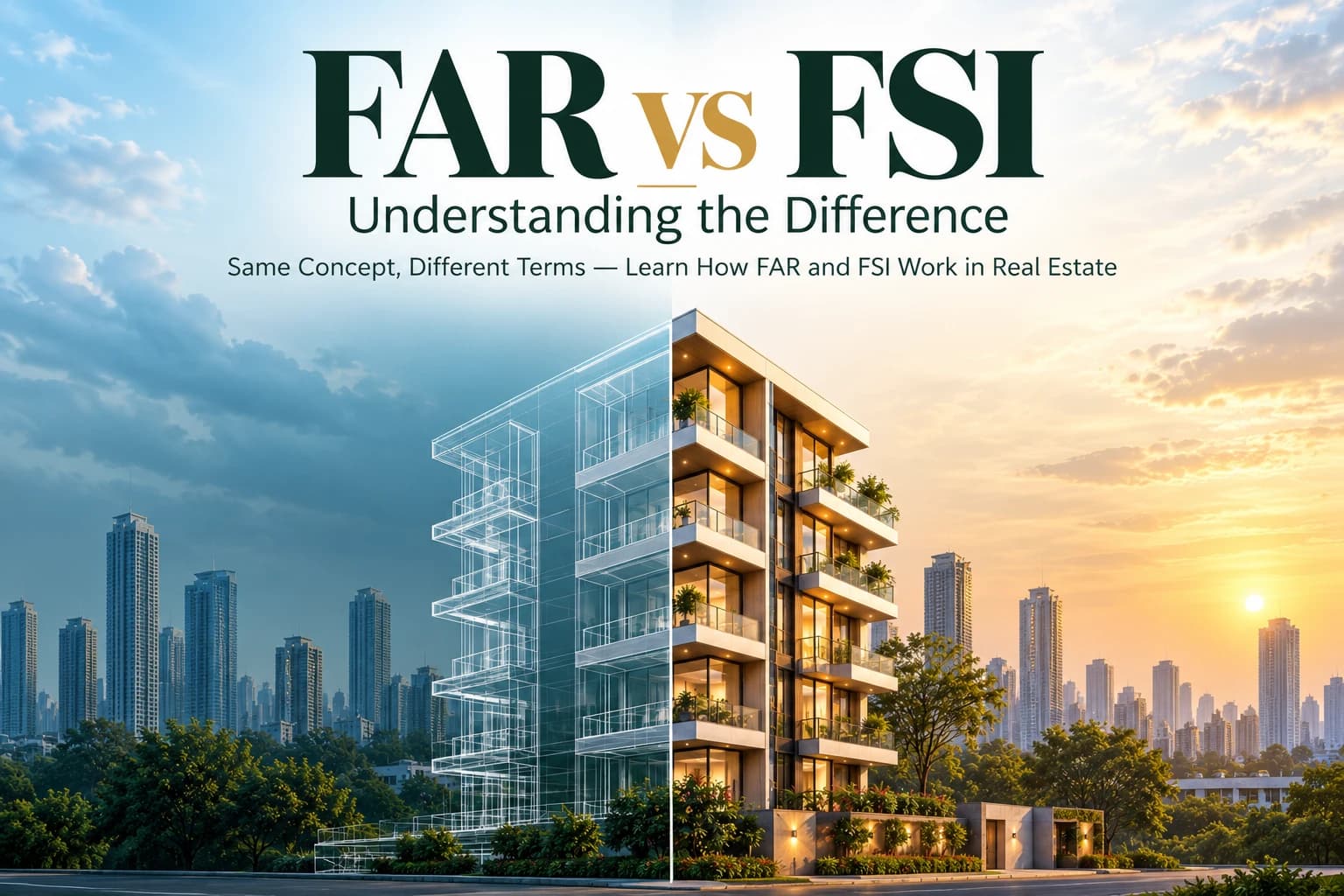
Here's the short answer: FAR and FSI describe the same idea. The real differences lie in how the number is written, where each term is used, and how local rules shape it. Let's walk through it properly, so the next time you see either term, you know exactly what it's telling you.
What Is FAR?
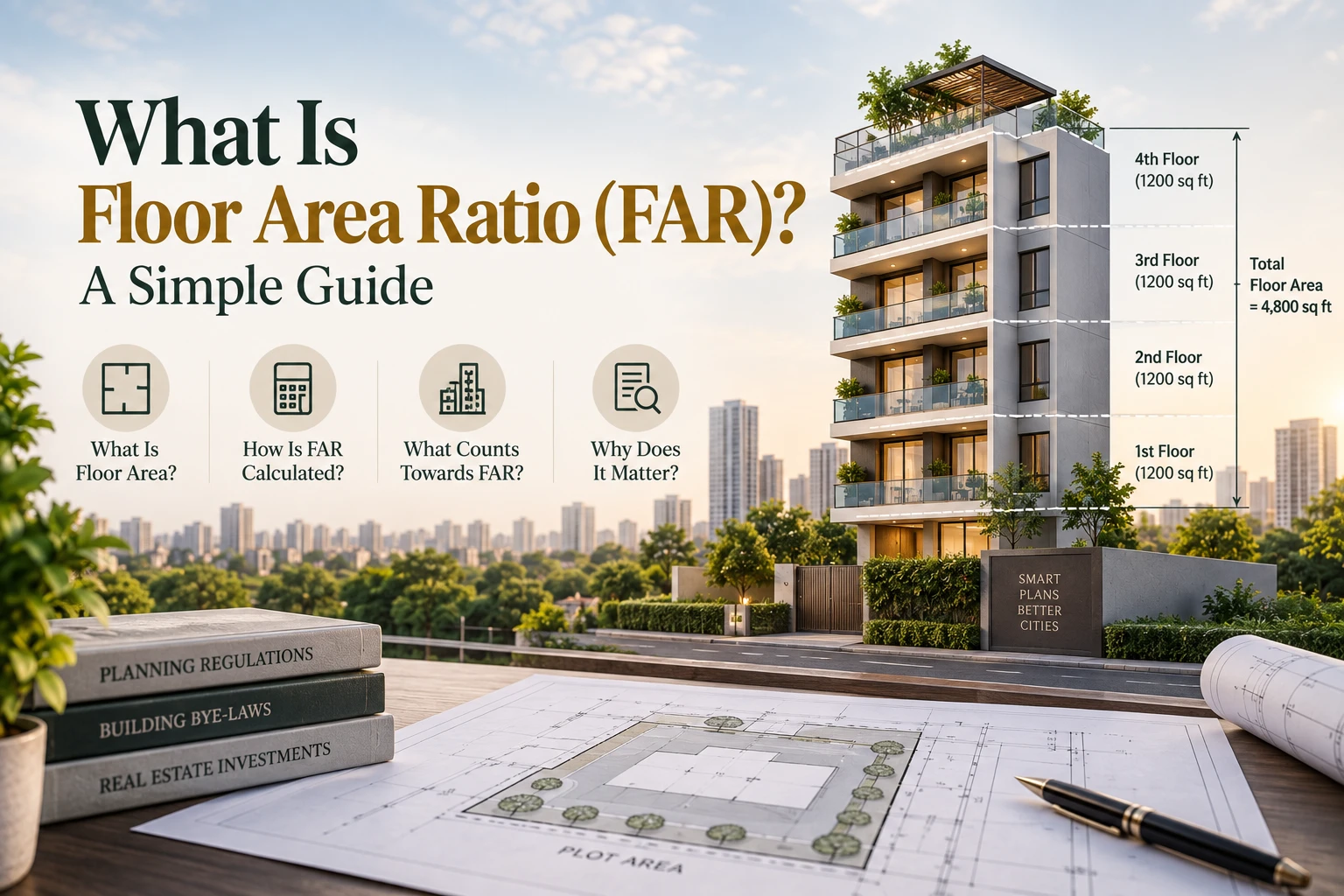
Floor Area Ratio (FAR) is the ratio of the total covered floor area of a building, across all floors, to the area of the plot it stands on. It tells you how much construction is allowed on a piece of land.
In North India, FAR is usually written as a percentage. So a FAR of 150% means you can build a total floor area equal to one and a half times the plot size.
What Is FSI?
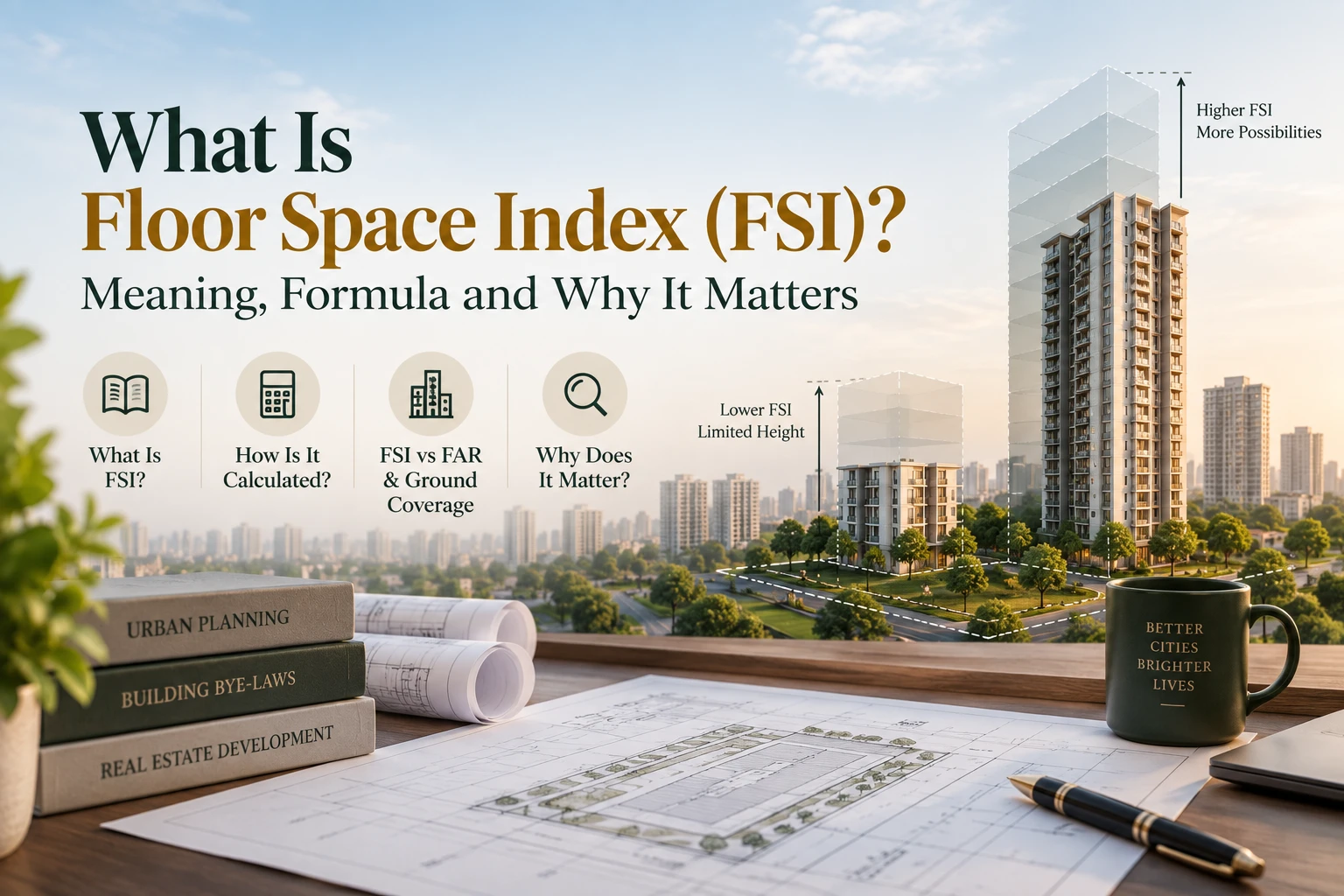
Floor Space Index (FSI) is the ratio of the total built-up area of a building to the plot area. It too tells you how much construction the land can legally carry.
FSI is usually written as a decimal or ratio, such as 1.5, 2 or 2.5. An FSI of 1.5 means you can build a total floor area of one and a half times the plot size.
If that sounds exactly like FAR, that's because it is.
Is There Any Real Difference Between FAR and FSI?
Conceptually, no. Both terms measure the relationship between the total floor area of a building and the size of the plot. Both are set by local planning authorities. Both decide how much can be built.
The difference between FAR and FSI comes down to three practical things:
How the number is written: FAR is often expressed as a percentage (150%, 200%), while FSI is usually expressed as a decimal (1.5, 2.0). That said, some cities write FAR as a decimal too, so don't rely on the format alone.
Where the term is used: Different states and development authorities simply prefer different terms in their building bye-laws.
What local rules count or exempt: Each authority decides what goes into the calculation. So an FSI of 2 in one city and a FAR of 200% in another may still allow different amounts of real construction, because their exemptions for basements, balconies, staircases or parking differ. This is a difference in local rules, not in the terms themselves.
How Are FAR and FSI Calculated?
The FAR and FSI formula is essentially the same:
FSI = Total Built-Up Area of All Floors ÷ Plot Area
FAR (%) = (Total Covered Area of All Floors × 100) ÷ Plot Area
Here's an example:
Say you have a 2,000 sq ft plot, and the building on it has a total covered area of 4,000 sq ft across all floors.
FSI = 4,000 ÷ 2,000 = 2
FAR = (4,000 × 100) ÷ 2,000 = 200%
Same building, same plot, same meaning. Only the way of writing it has changed.
How Do You Convert FAR to FSI and FSI to FAR?
Since both measure the same thing, converting FAR to FSI is simple:
FSI = FAR (%) ÷ 100
FAR (%) = FSI × 100
So a FAR of 175% equals an FSI of 1.75, and an FSI of 2.5 equals a FAR of 250%. If the FAR is already written as a decimal, it's identical to the FSI value, and no conversion is needed.
Where Is FAR Used and Where Is FSI Used in India?
There's no national rule on which term to use, so it depends on the state or city.
FAR is the more common term in Delhi, Haryana (including Gurgaon), Uttar Pradesh (including Noida) and Karnataka (including Bengaluru). In Delhi and Haryana, you'll usually see it as a percentage.
FSI is commonly used in Maharashtra (including Mumbai and Pune), Gujarat and Tamil Nadu (including Chennai).
If you're comparing projects across cities, it's worth converting everything into one format before drawing any conclusions.
Why Do Two Different Terms Exist?
It's largely a matter of history. Town planning in India developed city by city, with different authorities drafting their own master plans and building regulations over the decades. Some adopted the term FAR, others went with FSI, and the terms simply stuck in their respective regions.
Today, national documents like the Model Building Bye-Laws and the National Building Code acknowledge both terms as referring to the same concept.
What Are Some Common Misconceptions About FAR and FSI?
"FSI is bigger than FAR." Not true. An FSI of 2 and a FAR of 200% allow the same amount of construction under the same exemption rules. The numbers only look different.
"A higher FAR means bigger flats." Not necessarily. A higher FAR allows more total construction on the plot, but the developer might use it to build more flats rather than larger ones.
"FAR and ground coverage are the same." They're not. FAR controls total floor area across all floors, while ground coverage controls how much of the plot the building's footprint can occupy.
"Everything built counts towards FAR or FSI." Also not true. Basements used for parking, stilt floors, lift wells and certain balconies are often exempted, depending on local bye-laws.
How Are FAR and FSI Different from Ground Coverage?
Both FAR and FSI are about the total amount of construction. Ground coverage is about the footprint.
Take a 1,000 sq m plot with an FSI of 2 (or FAR of 200%) and ground coverage of 50%. You can build 2,000 sq m in total, but the footprint can't be more than 500 sq m. So the building would go up four floors to use its full FAR or FSI.
Knowing both numbers together gives you a clear picture of how tall and how spread out a building can be.
What Are Premium FSI, Purchasable FAR and TDR?
Some authorities allow extra construction beyond the base limit, through official channels:
Premium FSI and purchasable FAR both let a developer build additional floor area by paying a fee to the authority. The concept is the same; the name changes with the region.
Transferable Development Rights (TDR) are development rights given to landowners who surrender land for public use. These rights can be used on another plot or sold, allowing extra construction elsewhere.
In every case, the additional FAR or FSI must be formally approved. Building beyond the limit without sanction is unauthorised construction.
Why Should Buyers Care About FAR and FSI?
Whichever term your city uses, it affects you in the same ways.
It influences land value, since plots with a higher permissible FAR or FSI can support more saleable area. It shapes density and comfort, because more construction on the same land usually means more people sharing the same amenities. And it's key to legal safety, especially for builder floors and independent houses, where floors built beyond the approved limit can face penalties or demolition.
How Can You Check the FAR or FSI of a Property?
A few quick checks go a long way:
- Ask for the sanctioned building plan and note the approved FAR or FSI along with the total covered area.
- Read the local building bye-laws to understand what's counted and what's exempted.
- Check the RERA portal for registered projects and their approved plans.
- Convert the numbers into one format if you're comparing projects in different cities.
- Consult an architect or property lawyer if the construction doesn't seem to match the approvals.
The Bottom Line
When it comes to FAR vs FSI, the difference is more about language than meaning. Both tell you how much can be built on a plot. FAR tends to be written as a percentage and is common in North India, while FSI is usually written as a decimal and is common in western and southern states.
What really matters is the actual number, the local rules on what's counted, and whether the building sticks to what's been approved. Get those right, and it won't matter which term your city prefers.