What Is Floor Space Index (FSI)?
Ever wondered why two plots of the same size can end up with completely different buildings on them? One gets a modest four-storey structure, while the other rises into a high-rise tower. The difference usually isn't the builder's ambition. It's a number set by the local planning authority called the Floor Space Index, or FSI.
Whether you're buying a flat, investing in a plot or planning to build your own house, FSI quietly shapes how much can be built, how crowded a project feels and even how much the land is worth. Let's break it down in simple terms.
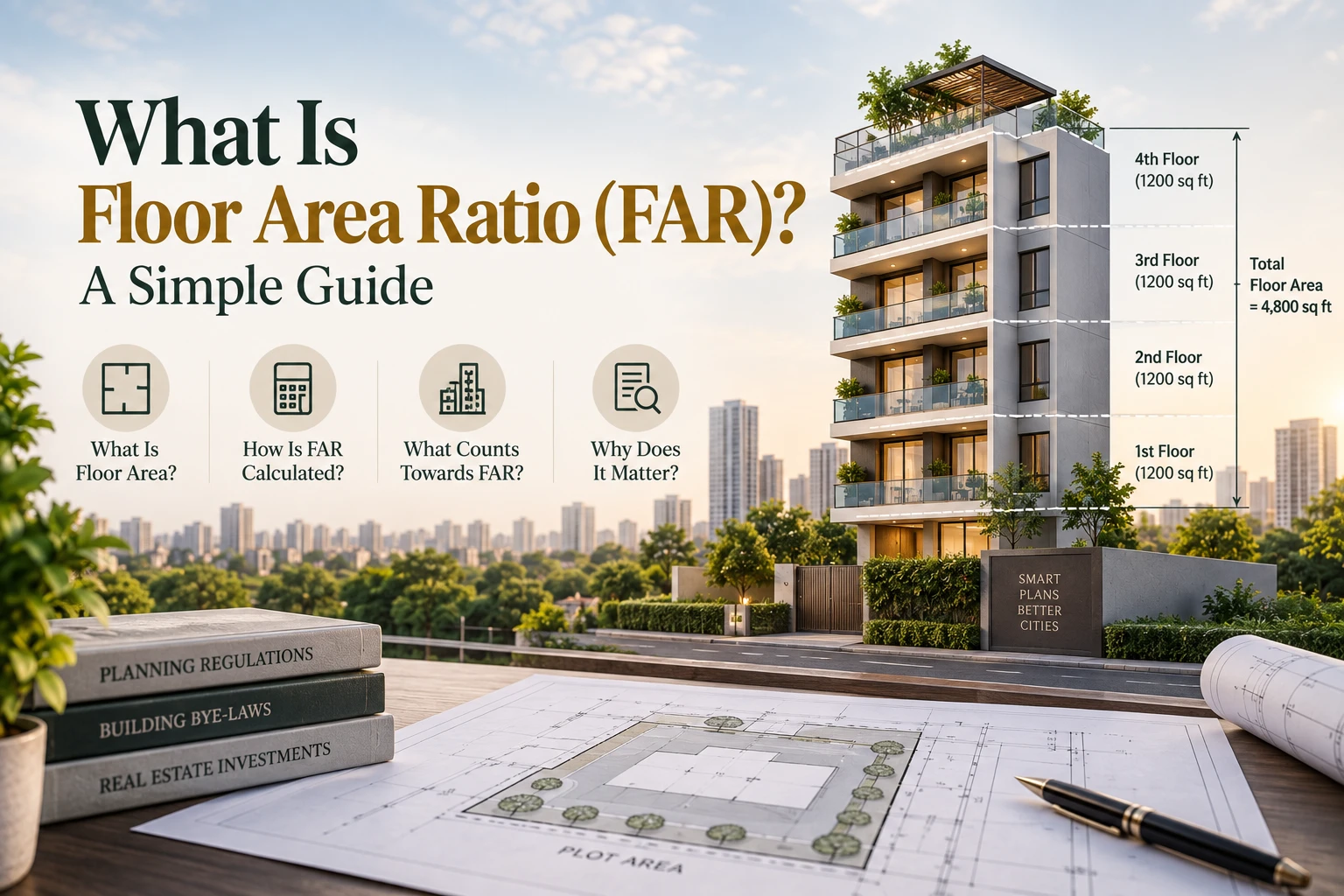
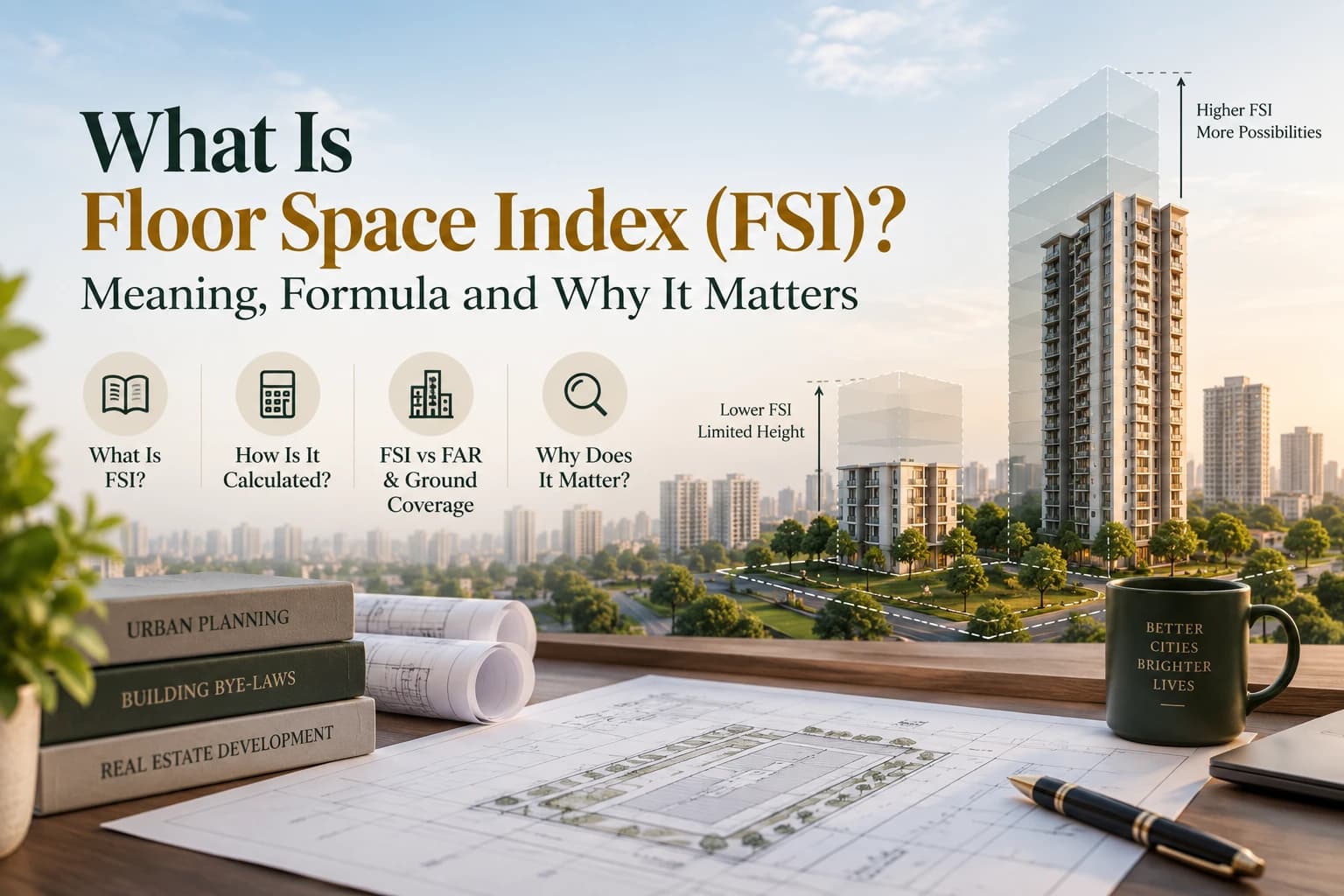
Floor Space Index (FSI) is the ratio between the total built-up area allowed on a plot and the size of the plot itself. In simple words, it tells you how much construction is permitted on a piece of land.
If a plot has an FSI of 1, you can build a total floor area equal to the plot's size. If the FSI is 2, you can build twice the plot area, spread across multiple floors.
The FSI meaning is the same across the country, but the actual FSI value changes from city to city, and often from one zone to another within the same city. It's decided by the local development authority through its building bye-laws or development control regulations.
What Is the FSI Formula?
The FSI formula is refreshingly simple:
FSI = Total Built-Up Area of All Floors ÷ Plot Area
Flip it around, and you get the maximum area you're allowed to build:
Permissible Built-Up Area = Plot Area × FSI
How Is FSI Calculated? A Simple Example
Say you own a plot of 2,000 sq ft, and the permissible FSI in your area is 1.5.
2,000 × 1.5 = 3,000 sq ft of total built-up area
That 3,000 sq ft can be arranged in different ways. You could build 1,500 sq ft on two floors, or 1,000 sq ft on three floors, as long as the total doesn't cross the limit and you follow other rules like height restrictions and setbacks.
Now take the reverse case. If a building has a total built-up area of 6,000 sq ft on a 3,000 sq ft plot, the FSI used is:
6,000 ÷ 3,000 = 2
Is FSI the Same as FAR?
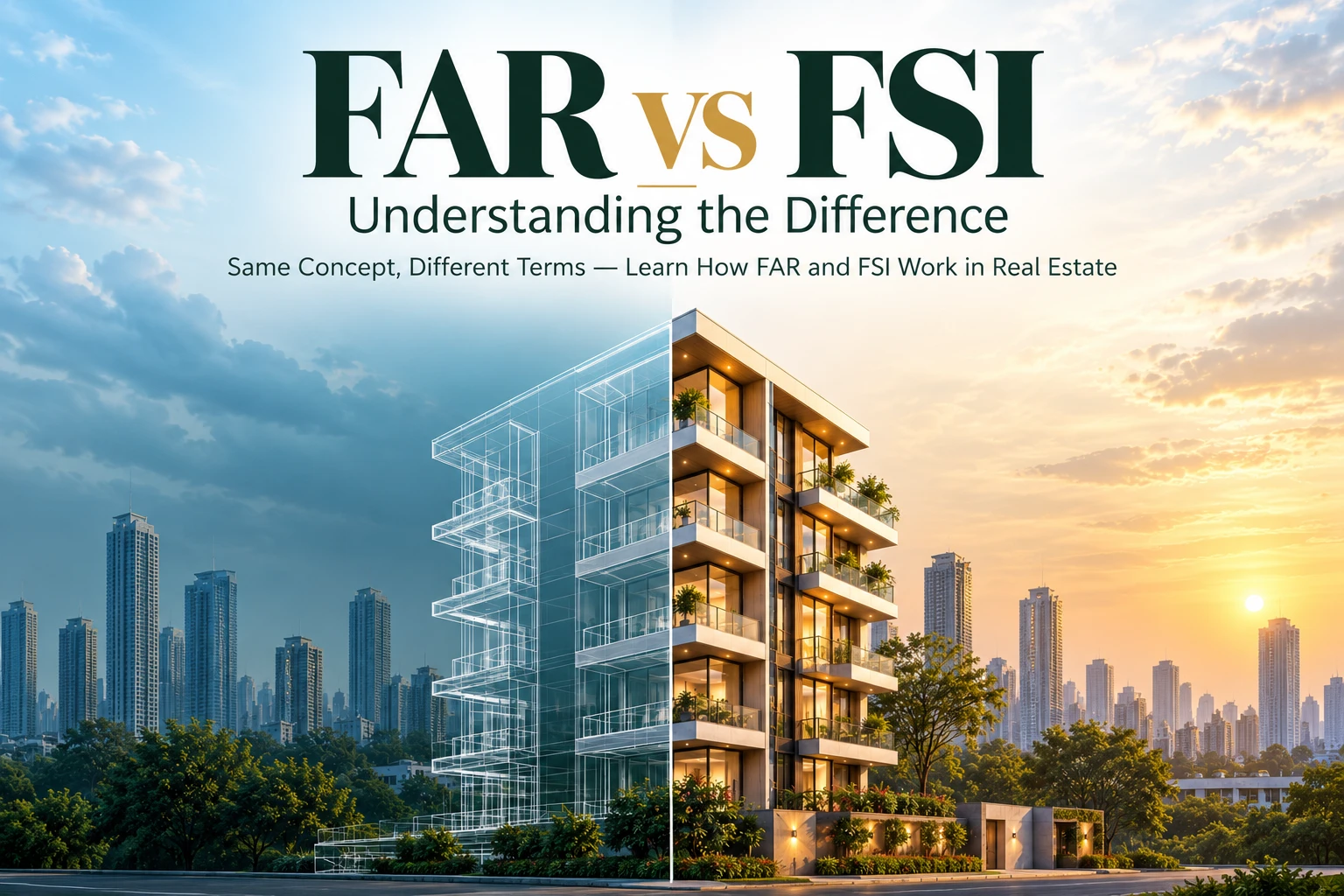
Yes, for all practical purposes. FSI and Floor Area Ratio (FAR) mean the same thing. The difference lies mainly in how the number is written and which term a state prefers.
FSI is usually expressed as a ratio or decimal, like 1.5 or 2.5. FAR is often expressed as a percentage, so an FSI of 1.5 would be written as a FAR of 150%. Maharashtra, for instance, commonly uses the term FSI, while Haryana and Delhi usually talk about FAR. If you're reading property documents in Gurgaon, expect to see FAR.
So when someone asks about FSI vs FAR, the honest answer is that they're two names for the same idea.
What Is the Difference Between FSI and Ground Coverage?
This is where many buyers get confused. FSI controls the total amount of construction across all floors. Ground coverage controls how much of the plot the building's footprint can occupy at ground level.
Here's how they work together. Suppose you have a 1,000 sq m plot with an FSI of 2 and a ground coverage limit of 40%.
The total permissible built-up area is 1,000 × 2 = 2,000 sq m. The building's footprint can cover only 40% of the plot, which is 400 sq m. To use the full 2,000 sq m, the building would need to go up five floors (2,000 ÷ 400).
In other words, FSI decides how much you can build, while ground coverage decides how spread out or how tall that construction becomes. The rest of the plot stays open for setbacks, driveways, greenery and light.
What Is Included and Excluded in FSI Calculation?
Not every square foot of a building counts towards FSI. The exact list depends on local bye-laws, but in many Indian cities, the FSI calculation generally includes:
- Habitable floor areas like rooms, kitchens and bathrooms
- Internal and external walls
- Enclosed spaces that are part of the usable floor area
Areas that are often exempted from FSI include:
- Basements used for parking or services
- Stilt parking on the ground floor
- Lift wells, staircases and machine rooms, in some cities
- Certain balconies, terraces and architectural features, within prescribed limits
Because these exemptions vary so much, a building can look much larger than its FSI suggests. That's perfectly legal as long as the exempted spaces follow the approved plan.
What Are Premium FSI and TDR?
In some cities, builders can construct beyond the basic FSI by paying for it or buying it.
Premium FSI is additional FSI that the authority sells to the developer for a fee. It lets them add more floors or more units than the base FSI allows.
Transferable Development Rights (TDR) work a little differently. When a landowner surrenders land for public use, such as road widening or a garden, the authority gives them development rights in return. These rights can be used on another plot or sold to a developer, who then gets to build extra area.
Mumbai is the best-known example where premium FSI and TDR play a major role in real estate development. Other cities have their own versions under different names.
Why Does FSI Matter to Home Buyers?
FSI isn't just a technical term for architects and builders. It affects buyers in some very real ways.
Density and living comfort: A higher FSI usually means more flats on the same land. That can mean more residents sharing the lifts, parking, clubhouse and open spaces.
Land value: Plots in areas with a higher permissible FSI generally command higher prices, because more saleable area can be built on them.
Future potential: If you own an independent house or an old building, the unused FSI on your plot could allow you to add floors later, or make your property attractive for redevelopment.
Legal safety: A building that exceeds its permitted FSI without approval can face penalties, sealing or even demolition. As a buyer, you don't want to be stuck with a flat in an unauthorised floor.
How Does FSI Affect Property Prices?
The relationship is fairly direct. When the authority raises the FSI in a zone, developers can build more on the same land, so the land itself becomes more valuable. At the same time, a larger supply of units can keep flat prices in check, depending on demand.
For plot owners, a higher FSI almost always means a better price. For flat buyers, it's more of a trade-off between affordability and the kind of open, uncrowded living a low-density project offers.
How Can You Check the FSI of a Project?
Before you invest, it's worth doing a little homework:
- Ask the developer for the sanctioned building plan and check the FSI or FAR mentioned in it.
- Visit your state's RERA website and look up the project using its registration number. Approved plans and project details are usually available there.
- Check the local development authority's bye-laws to see what FSI is allowed in that zone.
- Count the floors and units against what's approved, especially in older or plotted developments.
- Consult a property lawyer or architect if the numbers don't add up.
The Bottom Line
Floor Space Index is one of those numbers that rarely makes it to the front of a brochure, yet it shapes almost everything about a building, from how tall it stands to how many neighbours you'll have. Once you understand how FSI works alongside ground coverage and built-up area, you'll read project details with a much sharper eye.
So the next time you look at a plot or a new launch, ask about the FSI. It tells you not only what's been built, but also what's possible.