BSP in Real Estate: Why the Price on the Brochure Isn't the Price You Pay
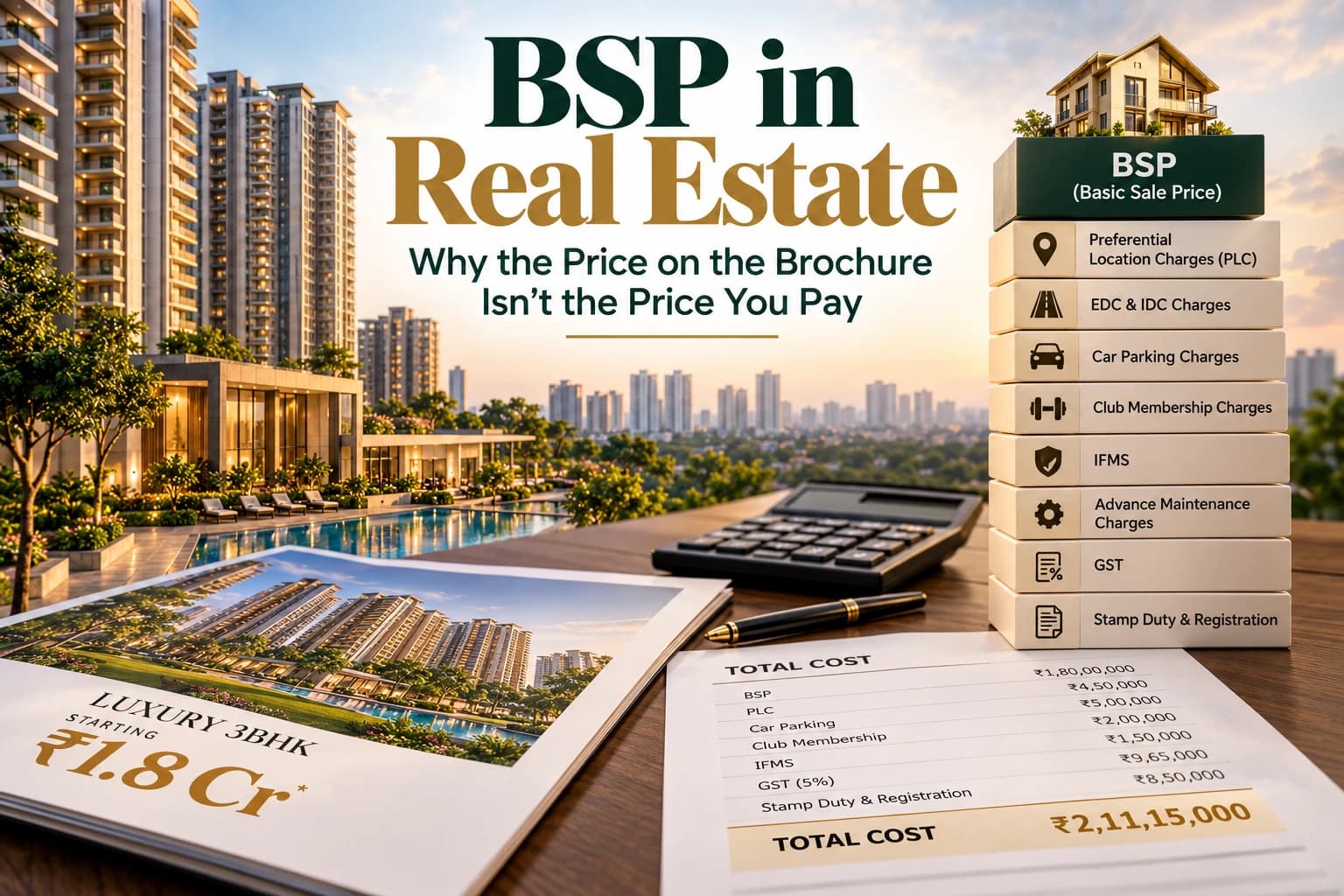
You see a hoarding on the expressway: "Luxury 3BHK starting ₹1.8 Cr." You call the number, visit the site, like the flat, and ask for the final cost. The sales executive pulls out a cost sheet, and suddenly the figure is ₹2.1 crore, sometimes more.
Where did the extra ₹30 lakh come from? The answer starts with understanding the BSP, the number most ads are built around, and all the charges that sit on top of it. If you're buying a new flat, especially in an under-construction project, this is one of the first things you need to get clear.
What Is BSP in Real Estate?
BSP stands for Basic Sale Price, sometimes called the basic selling price or base price. It's the core price of the property, usually quoted as a rate per square foot, before any additional charges, taxes, or fees are added.
Think of BSP as the price of the flat itself: the construction, the land cost, and the developer's margin. Everything else you pay, from parking and club membership to GST and stamp duty, is added on top.
That's why the BSP is almost always lower than the total cost or all-inclusive price of a property. It's the starting point, not the finishing line.
How Is BSP Calculated?
The basic formula is simple:
BSP = Rate per Sq Ft × Area of the Flat
Say a developer quotes a BSP of ₹12,000 per sq ft and the flat measures 1,500 sq ft.
BSP = 12,000 × 1,500 = ₹1.8 crore
One thing to watch closely is which area the rate is applied to. Traditionally, many developers quoted BSP on super built-up area. After RERA, the agreement for sale has to be based on carpet area, but marketing material and cost sheets still often show rates on super area. A ₹12,000 rate on super area and a ₹12,000 rate on carpet area are very different prices, so always ask which one you're looking at.
What Charges Are Added on Top of BSP?
This is where the gap between the advertised price and the final price comes from. The exact list varies by project and city, but these are the most common additions.
Preferential Location Charges (PLC). Flats with better views, corner positions, park or golf course facing units, or higher floors often carry an extra charge per sq ft. Some developers also charge floor rise charges, which go up with each floor.
External Development Charges (EDC) and Infrastructure Development Charges (IDC). In Haryana, including Gurgaon, developers pay these to the government for external infrastructure like roads, sewage, and water supply, and pass them on to buyers. Many projects now include EDC and IDC within the BSP, but older cost sheets and some projects still list them separately.
Car parking charges. Covered or basement parking is usually sold or allotted separately, and it can run into several lakhs per slot.
Club membership charges. A one-time fee for access to the clubhouse and its facilities.
Interest Free Maintenance Security (IFMS). A refundable deposit collected at possession, usually held by the developer or maintenance agency and later handed over to the residents' association.
Advance maintenance charges. Many developers collect one or two years of maintenance in advance at the time of possession.
Power backup and utility connection charges. Fees for power backup capacity, electricity meters, water connections, and sometimes gas pipelines.
GST. Under-construction properties attract GST. It's currently 5% for most residential units and 1% for units classified as affordable housing, without input tax credit. Ready-to-move properties with an Occupancy Certificate don't attract GST.
Stamp duty and registration charges. These are paid to the state government when the property is registered in your name. In Haryana, stamp duty differs for men, women, and joint owners, and the rates are revised from time to time, so check the current figures before you calculate.
What Is the Difference Between BSP and All-Inclusive Price?
The BSP is just the base cost of the flat. The all-inclusive price (sometimes shown as the total sale consideration or total cost) adds up the BSP and every other charge the developer collects: PLC, parking, club membership, EDC and IDC if separate, IFMS, and so on.
Some developers now advertise all-inclusive rates to keep things simpler for buyers. Others still lead with BSP because the lower number grabs attention. Neither is wrong, but when you compare two projects, make sure you're comparing all-inclusive price with all-inclusive price.
Even the all-inclusive price usually doesn't include stamp duty and registration, since those are paid to the government, not the developer. Add them separately to get your true cost of ownership.
How Is BSP Different from Circle Rate?
The circle rate, also called the collector rate or guideline value, is the minimum value set by the state government for properties in a particular area. It's used to calculate stamp duty.
The BSP is set by the developer based on market demand, project quality, location, and brand. In prime areas, the BSP is often well above the circle rate. Stamp duty is generally charged on whichever is higher, the transaction value or the circle rate.
A Simple Example: From BSP to Final Cost
Here's how the numbers can build up for a 1,500 sq ft flat. These are illustrative figures only.
The BSP at ₹12,000 per sq ft comes to ₹1.80 crore. Add a PLC of ₹300 per sq ft for a park-facing unit, which is ₹4.5 lakh. Add ₹5 lakh for a covered parking slot, ₹2 lakh for club membership, and ₹1.5 lakh as IFMS. That brings the developer's total to about ₹1.93 crore.
GST at 5% on the applicable amount adds roughly another ₹9 to ₹10 lakh. Then come stamp duty and registration, which can add several lakh more depending on who the property is registered in the name of.
The flat advertised at ₹1.8 crore ends up costing well over ₹2 crore by the time you get the keys. That's normal, as long as you know it's coming.
Is BSP Negotiable?
Often, yes. The BSP is the part of the price the developer controls, so it's usually where you have the most room to negotiate, especially during launches, festive offers, slow market phases, or when you're booking multiple units.
Some charges can also be negotiated or waived, such as club membership, PLC, or parking, depending on the developer. Government charges like GST, stamp duty, and registration are fixed and not negotiable.
Why Should Homebuyers Understand BSP?
It helps you budget realistically. If you plan your home loan and down payment around the BSP alone, you could fall short by 10% to 20% at the final stages.
It helps you compare projects. One project may have a lower BSP but charge heavily for PLC, parking, and club membership. Another may have a higher BSP that already includes most of these.
It affects your home loan. Banks generally finance a percentage of the property's cost, but some charges like stamp duty and registration aren't usually covered. Knowing the break-up helps you plan how much cash you'll need.
It protects you from surprises. Charges that aren't in writing at booking have a way of appearing at possession. A clear cost sheet with the BSP and every other charge listed protects you.
Tips Before You Book a Flat
- Ask for a detailed cost sheet. It should list the BSP and every additional charge, along with the area it's calculated on.
- Check whether the BSP is on carpet area or super area. This changes the real price significantly.
- Confirm what's included. Ask directly whether EDC, IDC, parking, club membership, and power backup are part of the BSP or charged separately.
- Factor in GST, stamp duty, and registration. Add them yourself to get the true cost.
- Get everything in writing. Verbal promises about waivers or discounts should appear in the allotment letter or agreement.
- Cross-check with RERA. Project details and the approved agreement format are available on the state RERA portal.
The Bottom Line
BSP is the basic price of the flat, the headline number that gets you in the door. But it's rarely what you'll actually pay. Between location charges, parking, club fees, maintenance deposits, GST, and stamp duty, the final cost can easily be 10% to 20% higher. Ask for the full cost sheet, understand every line on it, and compare projects on their total cost, not just their BSP.
Frequently Asked Questions About BSP
1. What is the full form of BSP in real estate?
BSP stands for Basic Sale Price. It's the base price of a property, usually quoted per sq ft, before additional charges and taxes.
2. Is BSP the final price of a flat?
No. The final price includes charges like PLC, parking, club membership, IFMS, and taxes such as GST, plus stamp duty and registration charges.
3. How do I calculate BSP for a flat?
Multiply the BSP rate per sq ft by the area of the flat. For example, ₹10,000 per sq ft on a 1,200 sq ft flat gives a BSP of ₹1.2 crore.
4. Is BSP calculated on carpet area or super area?
It can be either. After RERA, agreements must be based on carpet area, but many cost sheets and ads still quote rates on super area. Always confirm which one is being used.
5. What is PLC in real estate?
PLC stands for Preferential Location Charges. It's an extra amount charged for flats with better views, corner positions, or other location advantages within a project.
6. Is GST charged on BSP?
Yes, for under-construction properties. GST is currently 5% for most residential units and 1% for affordable housing. Ready-to-move properties with an Occupancy Certificate don't attract GST.
7. What are EDC and IDC charges?
EDC (External Development Charges) and IDC (Infrastructure Development Charges) are fees paid to the government in Haryana for external infrastructure. They may be included in the BSP or charged separately.
8. Is BSP negotiable?
Usually, yes. The BSP is set by the developer, so there's often room for negotiation, especially during launches or offers. Taxes and government charges aren't negotiable.
9. What is the difference between BSP and circle rate?
BSP is the price set by the developer. The circle rate is the minimum property value set by the government for calculating stamp duty.
10. Does a home loan cover the entire cost above BSP?
Not always. Banks usually finance a percentage of the property cost, and charges like stamp duty and registration are often not covered, so you'll need to arrange those yourself.