
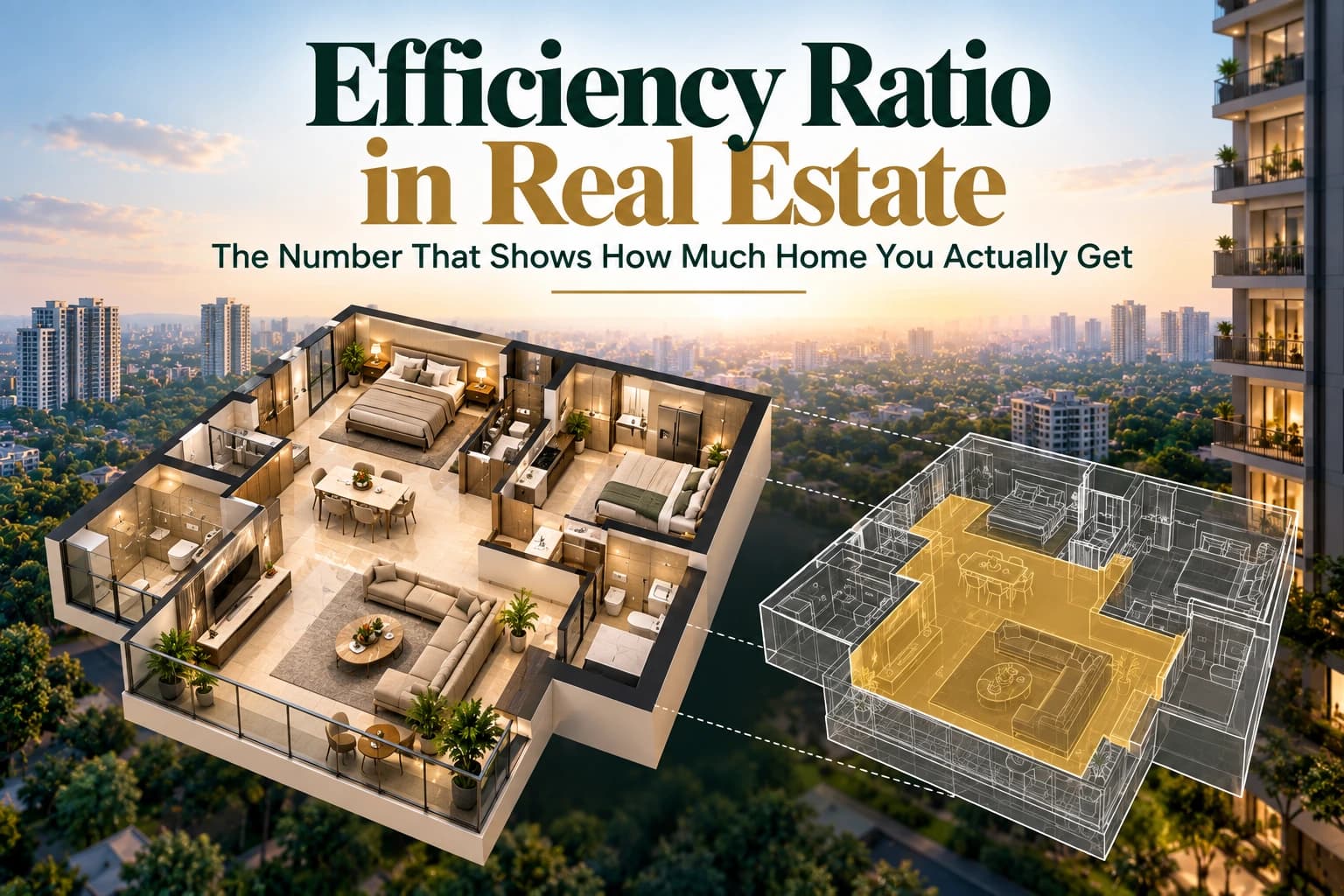
Efficiency Ratio in Real Estate: The Number That Shows How Much Home You Actually Get
Two apartments in the same sector, both advertised at around 2,000 sq ft. One is priced at ₹9,500 per sq ft, the other at ₹10,500. The first looks like the better deal, and most buyers would lean towards it without thinking twice.
Then you check the usable space inside each flat, and the picture flips. The "cheaper" one gives you around 1,300 sq ft to live in, while the pricier one gives you close to 1,560 sq ft. Per square foot of actual living space, the second flat costs less.
The number that reveals this is the efficiency ratio. It's one of the most useful and least discussed figures in Indian real estate, and once you understand it, you'll never compare flats the same way again.
What Is Efficiency Ratio in Real Estate?
The efficiency ratio (also called floor efficiency or flat efficiency) tells you what percentage of the area you pay for is actually usable space inside your home.
In simple terms, it compares your carpet area, the space inside your walls where you live, with the super built-up area, the total area the developer charges you for, which includes walls, balconies, and your share of common areas like lobbies, staircases, and lift shafts.
If a flat has an efficiency of 70%, it means that out of every 100 sq ft you pay for, 70 sq ft is usable living space and the remaining 30 sq ft goes into walls and shared areas.
How Is Efficiency Ratio Calculated?
The formula is straightforward:
Efficiency Ratio (%) = (Carpet Area ÷ Super Built-Up Area) × 100
Say your flat has a carpet area of 1,200 sq ft and a super built-up area of 1,700 sq ft.
Efficiency = (1,200 ÷ 1,700) × 100 = about 70.6%
That's all there is to it. The harder part is getting the correct carpet area from the developer, which is much easier now that RERA requires it to be disclosed.
How Is Efficiency Ratio Related to Loading Factor?
Efficiency and loading factor are two sides of the same coin. Loading tells you how much extra area has been added on top of the carpet area to reach the super area. Efficiency tells you how much of the super area is carpet area.
If you know one, you can work out the other:
Efficiency = 1 ÷ (1 + Loading %)
So a flat with 25% loading has an efficiency of 80%. A flat with 35% loading has an efficiency of around 74%, and a flat with 50% loading comes down to about 67%.
Developers often talk about loading because a figure like "only 30% loading" sounds modest. Efficiency is the more intuitive number for buyers, because it answers the question you actually care about: how much of my money is going into my own living space?
What Is a Good Efficiency Ratio for a Flat?
It depends on the type of building, but here's a general sense of what to expect.
In high-rise apartments, efficiency usually falls between 65% and 75%. Anything above 72% is generally considered good for a tower project with lifts, fire staircases, and decent lobbies.
Low-rise buildings and builder floors tend to be more efficient, often in the 80% to 90% range, since they have fewer lifts, smaller lobbies, and far less shared infrastructure.
Luxury high-rises sometimes dip to 60% or even lower. Grand entrance lobbies, wide corridors, large clubhouses, and extra service areas all eat into efficiency.
Commercial office spaces often have efficiencies in the 55% to 70% range because of large common areas, service cores, and circulation spaces.
A low number isn't automatically a red flag. What matters is whether the common areas you're paying for actually add value to your life.
Why Does Efficiency Ratio Matter for Homebuyers?
It reveals your real price per square foot. This is the biggest one. Divide the quoted price per sq ft on super area by the efficiency, and you get what you're really paying for each square foot of living space.
Go back to the example from the start. Project A is priced at ₹9,500 per sq ft with 65% efficiency, which works out to roughly ₹14,615 per sq ft of carpet area. Project B is priced at ₹10,500 per sq ft with 78% efficiency, which comes to about ₹13,460 per sq ft of carpet area. The flat that looked more expensive is actually the better value.
It affects your monthly maintenance. Most societies charge maintenance on super area. A low-efficiency flat means you pay maintenance on a lot of space that isn't inside your home.
It influences resale and rental value. Buyers and tenants care about how big a flat feels, not what the brochure says. A highly efficient flat usually feels larger than a less efficient one with the same super area, which helps when you sell or rent it out.
It helps you compare projects fairly. Every developer loads common areas differently. Efficiency puts every project on the same scale.
What Affects the Efficiency Ratio of a Project?
Several design and planning choices push efficiency up or down.
Building height. Taller towers need more lifts, larger lift lobbies, and additional fire staircases. Very tall buildings also need refuge areas for fire safety. All of this is common area that reduces efficiency.
Number of flats per floor. When more flats share a single core of lifts and staircases, the common area gets divided among more buyers, which improves efficiency. Two flats per floor feels exclusive and private, but it usually lowers efficiency compared with four flats sharing the same core.
Lobby and corridor design. Double-height entrance lobbies and wide corridors look impressive, but they come at a cost to efficiency.
Amenities loaded into the super area. Some developers include a share of the clubhouse, gym, and other facilities in the super area. Others don't. This alone can make a big difference.
Wall thickness and shafts. Thick structural walls and large service shafts for plumbing, electrical, and fire systems also take away from usable space.
Is a Higher Efficiency Ratio Always Better?
Not always. An unusually high efficiency in a high-rise can sometimes mean cramped lobbies, narrow corridors, too few lifts for the number of residents, or skimpy common facilities. You might gain a few square feet inside your flat and lose a lot of everyday comfort outside it.
The sweet spot is a project with reasonable efficiency and common areas that are genuinely useful: enough lifts to avoid long waits, well-lit lobbies, and amenities you'll actually use. Efficiency should be one of your checks, not the only one.
How Did RERA Make Efficiency Easier to Check?
Before the Real Estate (Regulation and Development) Act, 2016, many buyers never knew their carpet area, so calculating efficiency was nearly impossible. Developers quoted super area, and the loading was often a mystery.
RERA defined carpet area clearly and made it mandatory for developers to base the agreement for sale on carpet area. Project details are also available on each state's RERA portal. This means you can now get the carpet area from the agreement or the portal, take the super area from the brochure or price list, and calculate the efficiency yourself in a few seconds.
How to Use Efficiency Ratio Before Buying a Flat
- Ask for both figures in writing. Get the carpet area and the super built-up area for the exact unit you're considering.
- Calculate efficiency yourself. Don't rely on the sales team's numbers.
- Convert prices to carpet area. Divide the super area rate by the efficiency to see your true cost per usable square foot.
- Compare like with like. A 68% efficient luxury tower and an 85% efficient builder floor aren't directly comparable. Weigh what you get in return.
- Visit the site. Walk the corridors, check the lift lobbies, and see whether the common areas justify what they're costing you.
The Bottom Line
The efficiency ratio tells you how much of what you pay for is actually your home. It's a simple calculation, carpet area divided by super built-up area, but it cuts through a lot of marketing noise. Before you compare two flats on price per square foot, run this number. It often changes which deal is really the better one.
Frequently Asked Questions (FAQs)
1. What is efficiency ratio in real estate in simple words?
It's the percentage of the area you pay for that you can actually use inside your flat. It's calculated by dividing the carpet area by the super built-up area.
2. What is the formula for flat efficiency?
Efficiency (%) = (Carpet Area ÷ Super Built-Up Area) × 100. For example, a 1,050 sq ft carpet area and 1,500 sq ft super area give 70% efficiency.
3. What is a good efficiency percentage for an apartment?
For high-rise apartments, 70% to 75% is generally considered good. Builder floors and low-rise buildings often achieve 80% or more.
4. What is the difference between efficiency and loading?
Loading is the extra area added to the carpet area to reach the super area. Efficiency is the share of the super area that is carpet area. Higher loading means lower efficiency.
5. How do I convert loading percentage into efficiency?
Divide 1 by (1 + loading). For 40% loading, efficiency is 1 ÷ 1.40, which is about 71%.
6. Why do luxury projects have lower efficiency?
They usually have larger lobbies, wider corridors, bigger clubhouses, fewer flats per floor, and more service areas, all of which add to common space and reduce efficiency.
7. How do I calculate the actual price per sq ft of carpet area?
Divide the price per sq ft on super area by the efficiency. At ₹12,000 per sq ft super area and 72% efficiency, you're paying about ₹16,670 per sq ft of carpet area.
8. Does efficiency ratio matter in commercial property?
Yes, a lot. Office rents are often charged on chargeable or super area, so a low-efficiency floor means you pay rent on more space than your team can actually use.
9. Is a very high efficiency ratio always a good sign?
Not necessarily. In high-rise buildings, very high efficiency can mean narrow corridors, small lobbies, or too few lifts. Balance efficiency with the quality of common areas.
10. Where can I find the carpet area to calculate efficiency?
Check the agreement for sale, the developer's official price list, or the project's page on your state's RERA portal.