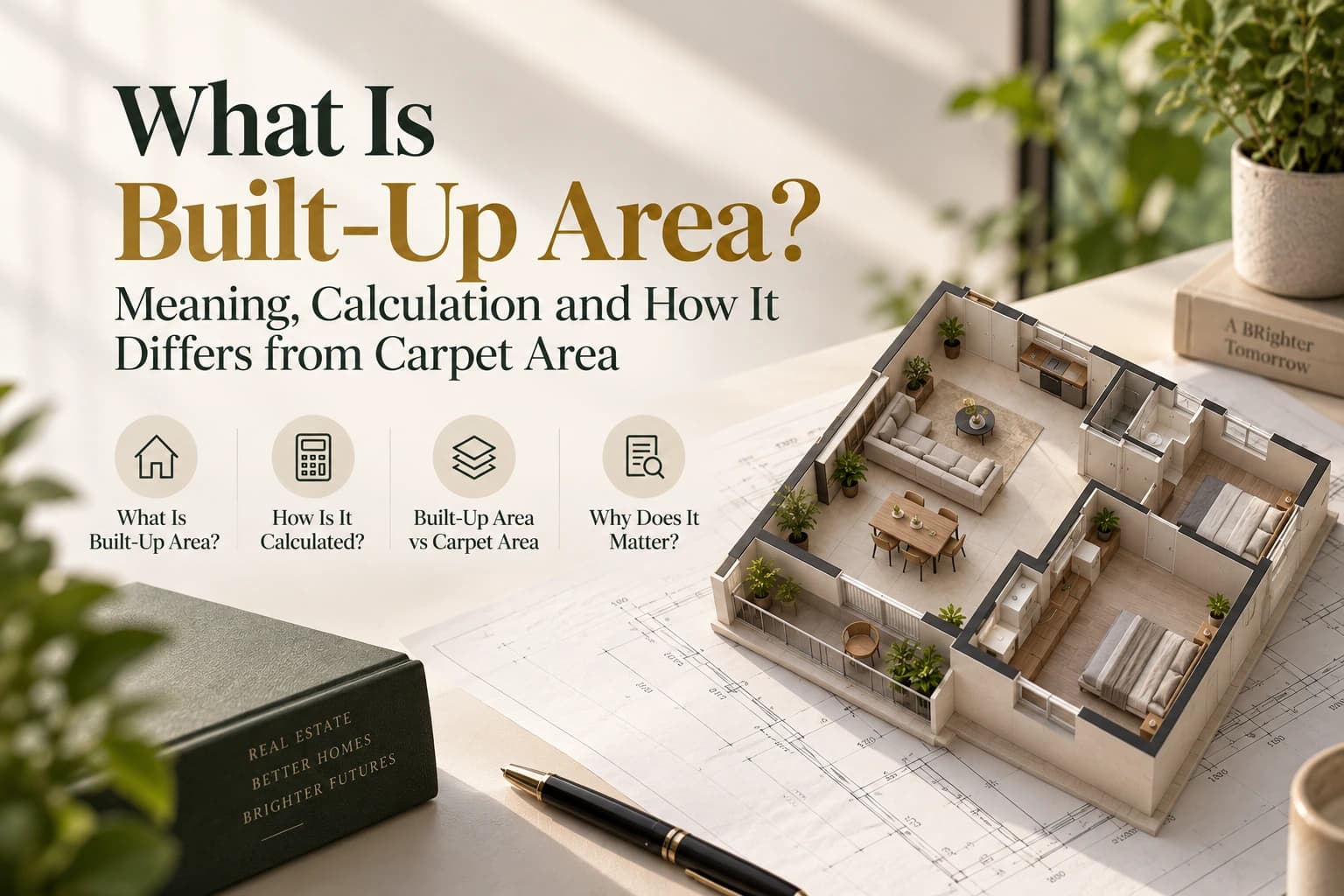
What Is Built-Up Area?
Pick up any property brochure and you'll see a number printed in bold: 1,250 sq ft, 1,800 sq ft, 2,400 sq ft. Most buyers assume that is the space they'll live in. It usually isn't. That figure could be the carpet area, the built-up area, or the super built-up area, and each one tells a very different story about your home.
If you're buying, renting or even comparing projects, knowing what built-up area means can save you from paying for space you'll never actually use. Let's break it down in plain language.
Built-up area is the total area of a flat or house that includes the usable floor space (the carpet area) plus the space taken up by the walls and certain attached areas like balconies. In simple terms, it's the carpet area with the thickness of the walls added back in.
Think of it this way. If you measured the floor of every room from wall to wall, you'd get the carpet area. If you then measured the same flat from the outer edge of its external walls, you'd get something close to the built-up area.
That's why the built-up area of a flat is always larger than its carpet area, even though you can't place a single piece of furniture inside a wall.
What Does Built-Up Area Include?
The components of built-up area generally cover:
- Carpet area, meaning the net usable floor space of all rooms, kitchen and bathrooms
- Internal and external wall thickness, the space occupied by the walls themselves
- Balconies and utility areas that belong exclusively to the unit
- Dry balconies, service areas and ducts attached to the flat, depending on how the developer measures them
What it does not include are the shared spaces of the building, such as lobbies, lifts, staircases, the clubhouse or the swimming pool. Those come in only when we talk about super built-up area.
How Is Built-Up Area Calculated?
There's no single rulebook that every developer follows, but the basic built-up area formula looks like this:
Built-Up Area = Carpet Area + Area of Walls + Balcony / Utility Area
In practice, the built-up area typically works out to about 10% to 20% more than the carpet area, depending on wall thickness and the size of the balconies.
Here's a quick example:
Say a 2BHK flat has a carpet area of 900 sq ft. The walls take up around 90 sq ft, and there's a 100 sq ft balcony.
900 + 90 + 100 = 1,090 sq ft built-up area
So while the flat is marketed at 1,090 sq ft, the space you actually walk and live on inside the rooms is 900 sq ft.
If you only have the carpet area and want a rough figure, many buyers use a simple thumb rule: carpet area × 1.2 = approximate built-up area. It's not exact, but it's useful when you're comparing listings quickly.
What Is the Difference Between Carpet Area, Built-Up Area and Super Built-Up Area?
This is where most of the confusion starts, so let's take the same 2BHK flat and look at it through all three measurements.
Carpet area is the usable floor space inside the walls, the area you can actually walk on, furnish and live in. In our example, that's 900 sq ft.
Built-up area takes the carpet area and adds the thickness of the walls along with the balconies and utility spaces that belong to the flat. For the same unit, this comes to 1,090 sq ft.
Super built-up area, also called saleable area or super area, adds your share of the building's common spaces: lobbies, corridors, lifts, stairs, the clubhouse, the gym and so on. The extra percentage the developer adds for these common areas is called the loading factor, and in many Indian projects it ranges from 25% to 40%.
So when comparing carpet area vs built-up area vs super built-up area, remember that the first one is what you use, the second is what's physically built for you, and the third is what you've historically been charged for.
How Much Bigger Is Built-Up Area Than Carpet Area?
As a general guide, the built-up area is 10% to 20% larger than the carpet area. Flats with thick external walls, large balconies or extra utility spaces sit at the higher end of that range. Compact units with thinner walls sit at the lower end.
If a listing shows a gap much bigger than this between the carpet area and the built-up area, it's worth asking the developer or broker exactly what has been counted.
Why Does Built-Up Area Matter When You Buy a Property?
Because it directly affects the price you pay. For years, many developers in India priced apartments on the super built-up area, which meant buyers were paying for walls, balconies and a share of corridors at the same per sq ft rate as their living room.
Understanding the built-up area in real estate helps you:
- Work out the real price per sq ft of usable space
- Compare two projects fairly, even if one quotes super area and the other quotes carpet area
- Spot unusually high loading in a project
- Plan your furniture and interiors realistically
For example, two flats priced at ₹1.2 crore might both be advertised as 1,500 sq ft. If one has a carpet area of 1,050 sq ft and the other has 1,150 sq ft, the second one is clearly the better deal.
What Does RERA Say About Built-Up Area?
Under the Real Estate (Regulation and Development) Act, 2016, developers must sell residential units on the basis of RERA carpet area, and that figure must be clearly mentioned in the agreement for sale.
RERA defines carpet area as the net usable floor area of the apartment, excluding external walls, service shafts, exclusive balconies and exclusive open terraces, but including the internal partition walls.
This doesn't mean built-up area and super built-up area have disappeared. You'll still see them in brochures, resale listings and conversations with brokers. What RERA does is ensure that the carpet area is disclosed, so you always have one honest number to work with. Before signing, check that the carpet area in your agreement matches what's registered on your state's RERA portal.
What Is Built-Up Area in an Independent House or Plot?
The meaning shifts slightly when you're dealing with an independent house, villa or builder floor. Here, built-up area usually refers to the total constructed area across all floors of the building, measured along the outer walls.
So if you build 1,500 sq ft on the ground floor and 1,500 sq ft on the first floor, your total built-up area is 3,000 sq ft, even though the plot itself might be only 2,000 sq ft.
This figure matters because local authorities limit how much you can construct on a plot through the Floor Area Ratio (FAR), also called Floor Space Index (FSI). Your permissible built-up area depends on the plot size and the FAR allowed in that zone.
Is Built-Up Area Used for Property Tax and Home Loans?
It can be. Several municipal bodies calculate property tax on the covered or built-up area of the property rather than just the carpet area, though the method varies from city to city. Banks, meanwhile, look at the agreement value, the registered area and their own valuation report when deciding your home loan amount.
Since the rules differ by location and lender, it's always wise to check with your local municipal authority and your bank before assuming which area figure they'll use.
Tips to Check Built-Up Area Before You Buy
A few simple checks can protect you from nasty surprises:
- Ask for all three figures in writing: carpet area, built-up area and super built-up area.
- Calculate the loading percentage yourself. If it's well above 35% to 40%, ask why.
- Verify the RERA carpet area on the state RERA website using the project's registration number.
- Measure the flat if it's ready to move. A regular measuring tape and a bit of patience will tell you a lot.
- Compare price per sq ft of carpet area, not super area, when you're choosing between projects.
The Bottom Line
Built-up area sits right in the middle of the three measurements you'll hear about when buying a home. It's bigger than the space you'll actually use, but smaller than the figure that includes lifts, lobbies and the clubhouse. Once you understand how carpet area, built-up area and super built-up area connect, property listings become much easier to read, and much harder to be misled by.
The next time you see a big number on a brochure, ask one simple question: which area is this? The answer could change how much value you're really getting for your money.